
Blog/News
THC Wax Prices: What Should You Expect to Pay?

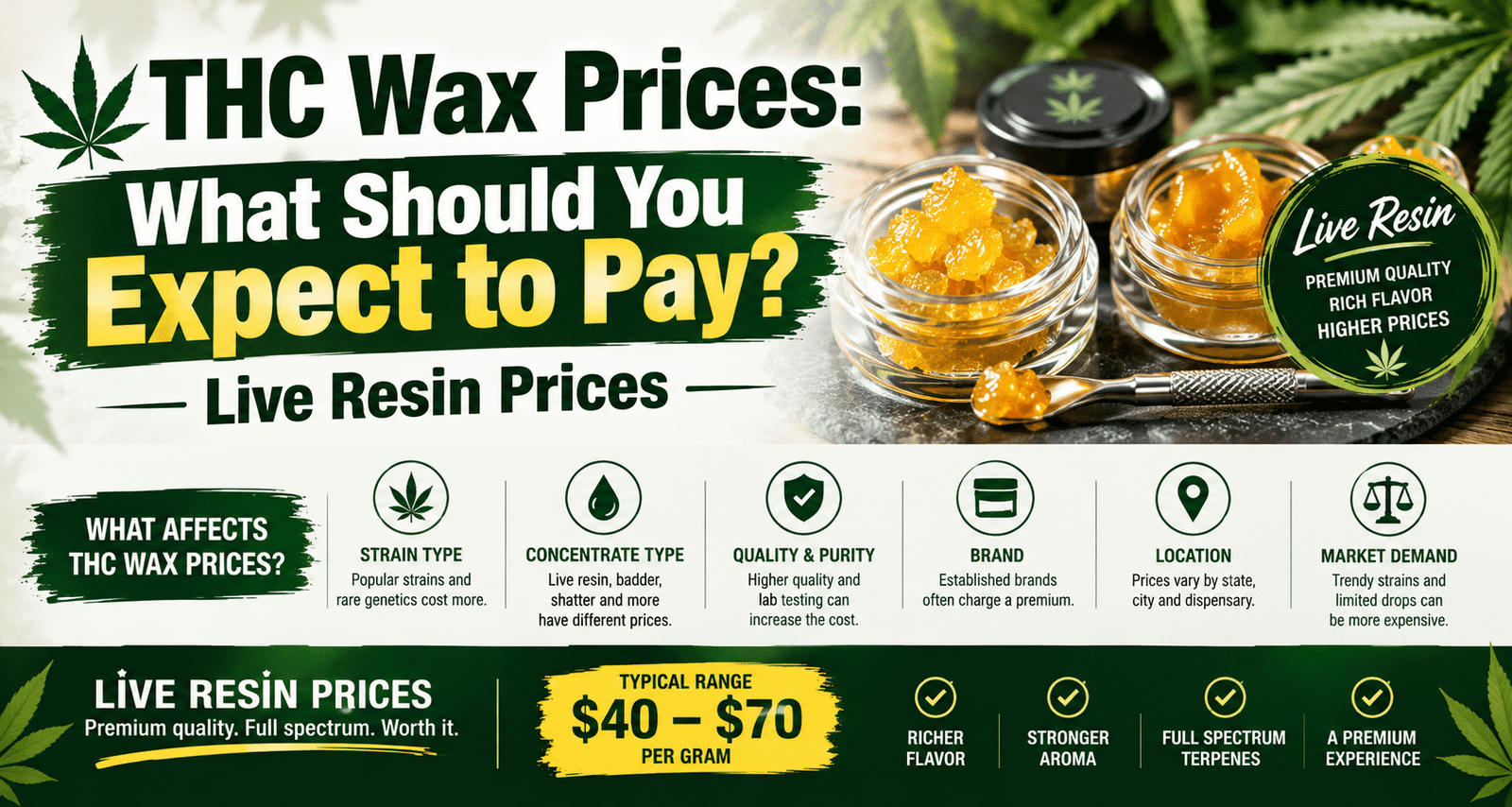
If you are researching THC wax prices, one of the first things to understand is that cannabis concentrates do not have one fixed price. The amount you may see advertised depends on the type of concentrate, its weight, brand, laboratory testing, production method, local taxes, and the legal cannabis market in your area.
THC wax is a cannabis concentrate made by extracting cannabinoids and other compounds from cannabis plant material. It is commonly associated with textures such as wax, budder, crumble, and shatter. Although these products can look different, their prices are influenced by many of the same factors.
In the United States, a gram is a common unit used to label and price cannabis concentrates. However, the price per gram is not necessarily a reliable measure of quality, purity, or safety. Two products with similar prices may have different cannabinoid profiles, manufacturing standards, and laboratory results.
For context, a July 2026 pricing guide for New York reports an average retail price of approximately $75 per gram for cannabis concentrates, with a listed range of $40–$110. These figures are specific to that market and should not be treated as a nationwide average. Source: New York cannabis price guide.
This article explains what THC wax costs, how different concentrate types compare, which factors influence prices, and how to interpret product labels when comparing prices in legal markets.
How Much Does THC Wax Cost?
THC wax prices vary considerably by location and product category. There is no single national price that applies to every dispensary, brand, or concentrate.
For general budgeting, shoppers researching legal cannabis markets may encounter prices ranging from a few tens of dollars to more than $100 per gram, depending on the market and product. These are broad illustrative ranges rather than verified nationwide averages or guaranteed current prices.
Typical THC Wax Price Ranges
The following table illustrates how concentrate pricing may be organized. These are indicative examples for comparison, not a live dispensary price list.
| Purchase size or category | Illustrative price range |
|---|---|
| Lower-priced concentrate, 1 gram | $20–$40 |
| Mid-priced concentrate, 1 gram | $40–$70 |
| Premium concentrate, 1 gram | $70–$110+ |
| Larger package | Depends on total weight, product type, and market |
Actual prices can fall outside these examples. Some markets have lower prices because of competition and discounts, while others have higher retail costs, taxes, or limited product availability.
How Much Is a Gram of THC Wax?
A gram is a standard comparison unit for many cannabis concentrates. However, the price of one gram depends on the specific product and the retailer.
For example, a $35 gram costs less upfront than a $70 gram, but that difference does not automatically establish which product offers better quality or value.
Why Price Estimates Differ
Online articles may report different THC wax prices because they use different locations, dates, concentrate categories, and pricing methods. Some report advertised shelf prices, while others use averages that incorporate discounts or bulk purchases.
For a useful comparison, look at the same product category, package weight, and tax treatment.
What Factors Affect THC Wax Prices?
Several variables influence the retail price of THC wax. Understanding them helps explain why two concentrates with similar weights can have noticeably different prices.
1. Type of Cannabis Concentrate
Concentrates are available in several forms, including wax, budder, crumble, shatter, and live resin. Their textures and production methods differ, which can affect manufacturing costs and retail positioning.
For example, a product made from fresh-frozen cannabis may be marketed differently from one produced using dried and cured plant material. However, the product name alone does not prove that it is more potent, purer, or better made.
2. Production Method and Starting Material
The starting material and extraction process can influence a concentrate’s cost.
Products made with particular starting materials or more specialized production methods may require additional equipment, processing, quality control, or labor. These expenses can contribute to higher retail prices.
A higher production cost does not automatically mean a safer product. Appropriate laboratory testing and transparent manufacturing information remain important.
3. THC Concentration and Cannabinoid Profile
THC concentration is another factor consumers may encounter when comparing wax products.
Some concentrates contain high percentages of THC, while others have different proportions of cannabinoids and aromatic compounds. Nevertheless, a higher advertised THC percentage does not necessarily mean a product is superior.
A complete product assessment should consider the laboratory results, cannabinoid profile, contaminants testing, and accuracy of the label rather than THC percentage alone.
4. Brand Reputation and Product Testing
Established brands may charge more because of their production standards, packaging, testing arrangements, or market positioning.
Laboratory reports can help verify cannabinoid content and identify potential contaminants, including residual solvents, pesticides, and heavy metals where those tests are applicable.
A credible certificate of analysis should correspond to the specific product or batch. Brand recognition by itself is not proof of safety.
5. Location, Taxes, and Retail Competition
Prices can differ substantially between states and even between retailers in the same city.
Cannabis tax structures are not uniform across the United States. Some jurisdictions use percentage-based taxes, while others use weight-based or potency-based approaches. Additional local taxes may also apply. Source: Tax Policy Center.
Local competition, licensing costs, inventory, and promotional discounts can also influence the amount a customer pays.
Why the Advertised Price May Not Be the Final Price
A displayed price may exclude applicable taxes. Other listings may show a promotional price that depends on eligibility or purchase conditions.
Always distinguish the advertised price from the final checkout total.
How Do Different Types of THC Wax Compare in Price?
The term THC wax is often used broadly to describe several cannabis concentrates. However, not every concentrate has the same texture, production method, or market price.
Wax
Wax typically has a soft, opaque, or slightly pliable consistency. Its appearance can range from creamy to firm, depending on the product.
The word wax describes a general physical form rather than a standardized quality grade. Two products labeled wax may differ in composition, production method, and price.
Budder
Budder generally has a creamy, whipped, or buttery texture. It may be marketed as a specialized concentrate, but its texture alone does not establish its potency or quality.
Prices depend on the specific formulation, brand, market, and product testing.
Crumble
Crumble is typically dry and crumbly, breaking apart more easily than softer concentrates. It may be priced similarly to other concentrates in the same product category, although individual retail prices vary.
Shatter
Shatter is usually a firm, glass-like concentrate that can break into pieces. Its appearance is different from wax or budder, but appearance is not a reliable indicator of purity.
Live Resin
Live resin is generally made using fresh-frozen cannabis material to preserve a different profile of aromatic compounds. It is often marketed as a premium concentrate, although actual prices vary by producer and retailer.
Is One Concentrate Always More Expensive Than Another?
No. There is no universal pricing rule that makes live resin, shatter, budder, crumble, or wax consistently the most expensive.
Retailers may price products according to production costs, brand positioning, demand, laboratory testing, and local competition.
Texture Is Not a Quality Rating
A smooth, glassy, creamy, or crumbly appearance does not establish whether a concentrate is safe or accurately labeled.
Laboratory results, manufacturing transparency, and compliance with local regulations are more useful indicators than appearance alone.
How Can You Compare THC Wax Prices and Product Value?
Comparing cannabis concentrate prices requires more than looking at the lowest advertised number. Weight, product classification, testing, taxes, and labeling all influence how useful a price comparison will be.
Compare the Same Package Weight
Start by checking the labeled quantity. A one-gram product should not be compared directly with a larger package without calculating the price per gram.
The basic calculation is:
Price per gram = Total product price ÷ Total grams
For example, if a hypothetical package costs $60 and contains two grams, the price before any additional taxes is $30 per gram.
This calculation helps normalize prices, but it does not establish that the products being compared are equivalent.
Check the Laboratory Report
Look for a certificate of analysis from a qualified laboratory where testing is required or available. Check that the report matches the product and batch, and review the results for cannabinoid content and relevant contaminants.
A product’s advertised THC percentage should not be the only consideration.
Read the Product Label Carefully
Check the net weight, cannabinoid information, ingredients where applicable, manufacturer details, batch identification, and any required warnings.
Packaging and labeling rules vary by jurisdiction, so the exact information available may differ.
Account for Taxes and Discounts
A lower shelf price may not translate into a lower final price if taxes or other charges differ.
Likewise, a promotional price may not represent the product’s regular retail cost. Comparing the final price under the same conditions produces a more meaningful result.
Consider Safety Alongside Cost
A low price is not necessarily a bargain if the product has unclear sourcing, unreliable labeling, or missing testing information.
Cannabis concentrates can contain very high levels of THC. High-potency products can increase the risk of unpleasant effects, including anxiety, confusion, impaired coordination, and other adverse reactions.
Is More Expensive THC Wax Better?
Not necessarily.
A premium price can reflect brand positioning, production costs, or market demand rather than a measurable improvement in safety or quality.
A more meaningful comparison considers transparent testing, reliable labeling, legal compliance, and the product’s documented composition.
THC Wax Prices: Frequently Asked Questions
Is THC wax more expensive than cannabis flower?
It can be more expensive per gram, but prices vary by location, product type, and market. Concentrates and flower are different products, so a simple price-per-gram comparison does not account for differences in potency or composition.
How much does one gram of THC wax cost?
There is no fixed nationwide price. Illustrative retail examples range from around $20 to more than $100 per gram, depending on the market and product. A New York pricing guide published in 2026 reports an average of approximately $75 per gram for concentrates in that state. Source.
Why is live resin sometimes more expensive than regular wax?
Live resin may involve specialized handling and processing of fresh-frozen cannabis material. These production requirements can affect costs, but not every live resin product costs more than every wax product.
Does higher THC content mean higher prices?
Not always. THC concentration is one pricing consideration, but brand, production methods, testing, taxes, and local supply also matter.
Are cheaper THC concentrates lower quality?
Not automatically. Discounts, local competition, and differences in operating costs can produce lower prices. However, an unusually low price combined with missing testing or unclear labeling warrants caution.
Do THC wax prices include taxes?
That depends on the retailer and jurisdiction. Some advertised prices exclude applicable taxes, while others display prices that already incorporate certain charges.
Why do THC wax prices vary between states?
States have different licensing requirements, tax systems, retail markets, and levels of competition. These differences can affect the final price paid by consumers.
Is THC wax legal everywhere in the United States?
No. Cannabis laws differ between states, and marijuana remains subject to federal prohibition. Consumers should check the laws that apply to their location and circumstances before possessing or purchasing cannabis concentrates.
What is the best way to compare THC wax prices?
Compare the same package weight and product category, calculate the price per gram, check the final price after applicable taxes, and review available laboratory testing and labeling information.
Final Thoughts on THC Wax Prices
THC wax prices depend on a combination of product characteristics, production methods, brand positioning, laboratory testing, local taxes, and retail competition. There is no single price that accurately represents every cannabis concentrate market.
For a general budgeting reference, shoppers may encounter prices ranging from a few tens of dollars to more than $100 per gram, although local prices can fall outside that range. State-specific price guides are more useful than treating any one figure as a national average.
The most important takeaway is that price alone cannot establish the quality, purity, safety, or value of THC wax. Package weight, product classification, transparent laboratory results, accurate labeling, and the final after-tax cost provide a more complete basis for understanding retail prices.
Cannabis concentrates can be substantially more potent than traditional cannabis flower. Their effects and risks can therefore differ, and high-THC products warrant particular caution.
Cannabis laws and retail regulations also change over time. Anyone researching THC wax prices should use current, location-specific information and verify the applicable legal requirements.
This article is for general educational purposes and is not medical or legal advice.