
Blog/News
How to Tell If THC Wax Is Pure: A Complete Guide to Quality and Safety

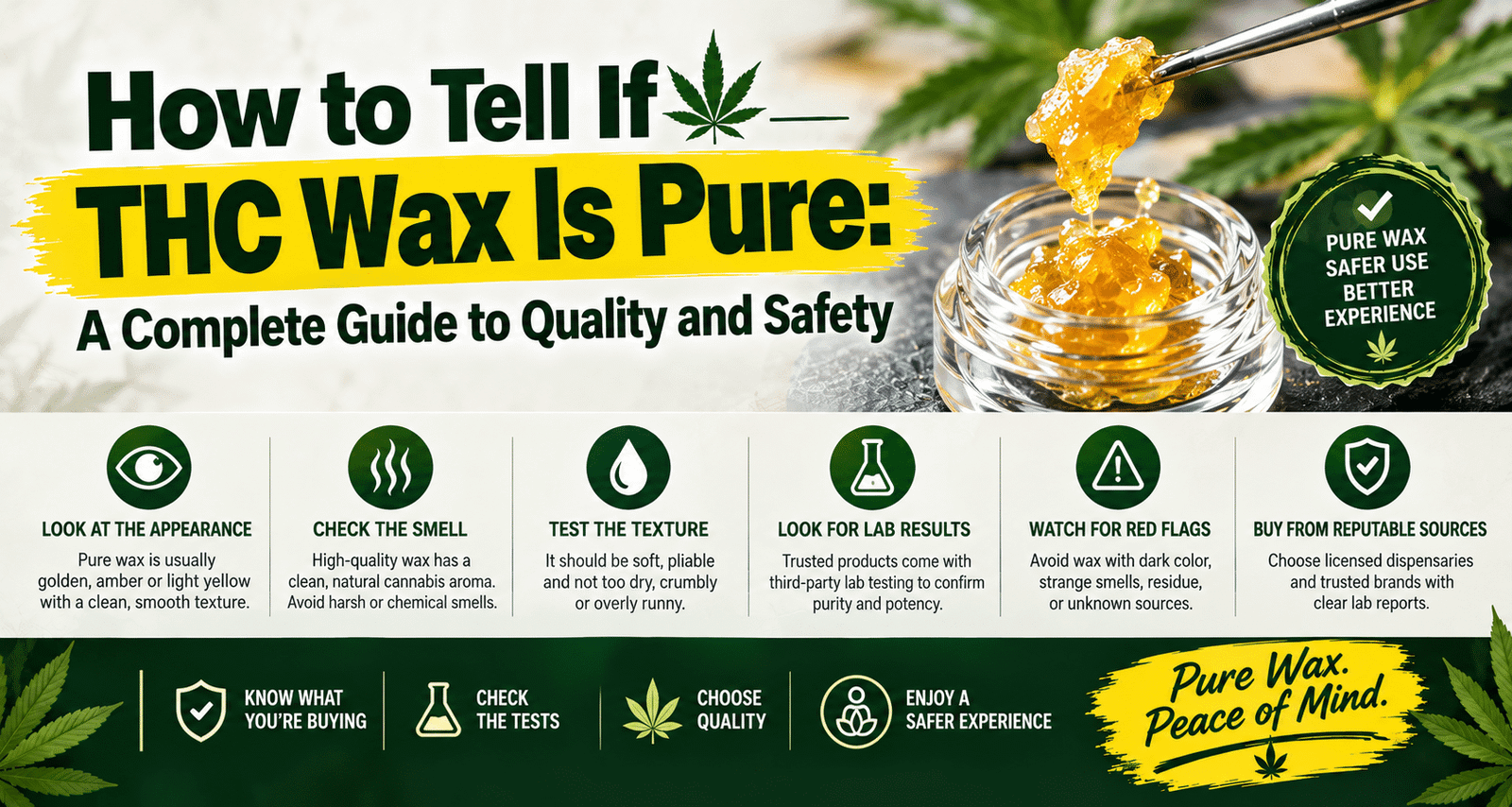
THC wax is a concentrated cannabis extract that can contain much higher levels of tetrahydrocannabinol (THC) than traditional cannabis flower. Because it is a concentrated product, its quality and purity matter. Consumers researching how to tell if THC wax is pure should understand that appearance, texture, smell, and color can offer clues about product quality, but none of these characteristics can confirm that a concentrate is free from harmful contaminants.
The most reliable way to assess THC wax purity is to review a current, batch-specific Certificate of Analysis (COA) from a qualified laboratory. This report can show the product’s cannabinoid potency and whether it passed applicable tests for residual solvents, pesticides, heavy metals, microbial contaminants, and other substances. Testing requirements vary by jurisdiction and product type. California’s Department of Cannabis Control explains the role of laboratory testing in verifying cannabis product quality and safety.
This guide explains the differences between visual quality checks and scientific purity testing, how to read laboratory reports, which warning signs deserve attention, and how to make more informed decisions about THC wax.
1. What Does Pure THC Wax Mean?
Pure THC wax is often understood as a cannabis concentrate with a high cannabinoid content and minimal unwanted substances. However, the word pure can mean different things depending on whether someone is discussing potency, chemical composition, manufacturing quality, or contamination.
A product can contain a high percentage of THC and still have unwanted residues. Likewise, a concentrate with a natural color or appealing texture is not necessarily safe.
THC Potency Is Different From Purity
THC potency describes how much THC a product contains. Purity is a broader concept that includes the presence or absence of unwanted chemicals and contaminants.
For example, a laboratory report might show a high THC percentage while also identifying a failed residual-solvent test. In that situation, the high potency does not make the product pure.
What Should a Quality Assessment Include?
A meaningful evaluation considers several factors:
- Cannabinoid profile: The measured amounts of THC, CBD, and other cannabinoids.
- Residual solvents: Chemical solvents that may remain after extraction.
- Pesticide residues: Agricultural chemicals that may carry over from the source material.
- Heavy metals: Potentially harmful metals, including lead, arsenic, cadmium, and mercury.
- Microbial contaminants: Certain bacteria, fungi, or other microorganisms.
- Mycotoxins: Toxic substances produced by certain molds.
- Product identity: Whether the tested sample matches the product and batch being sold.
Not every jurisdiction requires identical tests for every concentrate. The applicable testing rules and the type of extraction process determine which analyses are relevant.
Does Pure THC Wax Have to Be 100% THC?
No. Cannabis wax naturally contains compounds other than THC, including other cannabinoids and, depending on the product, terpenes and other plant-derived substances.
A product does not need to be 100% THC to be well-made or pass applicable safety tests. In fact, a laboratory report showing a realistic cannabinoid profile is more informative than a marketing claim that a product is completely pure.
2. How to Check THC Wax Appearance, Color, and Texture
Appearance can help identify obvious quality concerns, but it cannot establish chemical purity. Cannabis concentrates are produced using different extraction and processing methods, so their color and consistency can vary considerably.
What Color Should Pure THC Wax Be?
THC wax may appear pale yellow, golden, amber, tan, or darker brown, depending on the starting material, extraction process, processing conditions, and storage history.
A light color does not automatically mean that a product is pure. A darker concentrate is not necessarily contaminated, either.
Color Warning Signs
Be cautious when a product has unexpected discoloration, visible foreign particles, or signs of moisture or mold. These observations do not identify a specific contaminant, but they are reasons to stop and seek clarification from the licensed seller.
Do not taste, heat, or inhale a suspicious product to test its quality.
What Texture Should Quality THC Wax Have?
Concentrates can have different consistencies, including waxy, creamy, brittle, glass-like, or sticky textures. These differences often reflect how the product was manufactured and handled.
There is no single texture that proves THC wax is pure.
Texture Changes to Watch For
Unexpected changes during storage, unusual wetness, visible foreign material, or signs of a damaged or improperly sealed container deserve attention.
However, ordinary changes in consistency can also result from temperature fluctuations or the product’s formulation. Texture alone cannot tell you whether residual solvents or pesticides are present.
Can Bubbles or Crystals Reveal Purity?
No. Bubbles, crystals, and changes in consistency can arise from different physical and chemical processes. Their presence does not establish that a concentrate is contaminated, and their absence does not prove that it is safe.
Important: Visual inspection is useful for spotting obvious problems, not for confirming the absence of invisible chemical contaminants.
3. How to Identify THC Wax Purity Through Laboratory Testing
Laboratory testing is the strongest available method for evaluating the measured composition and tested contaminants of a THC wax product. In regulated cannabis markets, testing laboratories issue a Certificate of Analysis, commonly called a COA, to document the results for a specific sample or batch.
What Is a Certificate of Analysis?
A COA is a laboratory report that identifies a sample and presents its test results. Depending on the product and applicable regulations, it may include cannabinoid potency, terpene measurements, and contaminant screening.
The New York State Office of Cannabis Management’s guide to reading a cannabis COA explains how consumers can interpret these reports.
How to Check a COA
Before relying on a report, verify the following:
- Product name: Does the report identify the correct concentrate?
- Batch or lot number: Does it match the packaging?
- Laboratory identity: Is the laboratory qualified or authorized under the relevant rules?
- Report date: Is the report appropriate for the batch and current product?
- Test coverage: Does the report include the relevant contaminants?
- Results: Are the tests marked as passing under the applicable limits?
- Report authenticity: Can the report be verified through the laboratory, seller, or official tracking system?
A report for a different product or batch does not establish the purity of the product in your possession.
Which Contaminants Should THC Wax Be Tested For?
The most relevant testing categories depend on the extraction method and local regulations.
Residual Solvents
Some extraction processes use solvents that must be removed or controlled. Laboratory analysis can identify whether specified residual solvents remain above permitted limits.
A product that fails applicable solvent testing should not be treated as safe simply because it looks or smells normal.
Pesticides and Heavy Metals
Pesticide testing evaluates residues from agricultural chemicals. Heavy-metal testing can identify substances such as lead, arsenic, cadmium, and mercury.
These contaminants generally cannot be identified reliably by sight, smell, or texture.
Microbial Contaminants and Mycotoxins
Laboratories may test for specified microorganisms and toxins associated with certain molds. The relevant tests depend on the product type and local testing requirements.
A COA should be reviewed as a whole rather than relying on one favorable result.
What Does a Passing Laboratory Result Mean?
A passing result means that the tested sample met the applicable criteria for that particular test. It does not necessarily mean that every conceivable contaminant was tested for or that every unit in a batch is guaranteed to be identical.
A useful starting point is the California Department of Cannabis Control’s testing guidance, which describes how laboratory reports document potency and contaminant testing.
4. Warning Signs That THC Wax May Be Contaminated or Poor Quality
Consumers often search for obvious signs of impure THC wax because they want a quick way to assess a product. Unfortunately, many harmful contaminants cannot be detected at home.
The safest approach is to combine basic packaging checks with a review of laboratory documentation and the credibility of the seller.
Unusual Smells or Visible Foreign Material
A concentrate with an unexpected chemical odor, visible debris, or signs of contamination should not be used until the concern has been resolved.
However, a strong aroma is not proof of contamination, and a mild aroma does not prove purity. Natural terpenes and other compounds can produce different scents.
Do Not Use Smell as a Solvent Test
Some residual solvents may not be detectable by smell at hazardous concentrations. Other odors may come from normal product ingredients or manufacturing differences.
Never intentionally inhale vapors or heat a concentrate to determine whether it contains solvents.
Missing Labels or Unverifiable Lab Reports
Packaging that lacks clear product identification, batch information, ingredient details where required, or accessible testing documentation deserves extra scrutiny.
A QR code by itself is not proof of authenticity. Check that it leads to a report matching the exact product and batch.
Unsupported Purity or Potency Claims
Be cautious about claims such as:
- “100% pure THC” without supporting analytical results.
- “Lab tested” without an identifiable report.
- “Solvent-free” without appropriate evidence.
- “Medical grade” without a verifiable regulatory basis.
- “Guaranteed safe” based solely on appearance.
Marketing language cannot substitute for laboratory analysis.
What Should You Do If You Suspect Contamination?
Do not consume the product or attempt to clean, filter, or otherwise process it yourself. Keep it securely stored away from children and pets, and contact the licensed seller or relevant regulatory authority for guidance.
If using a concentrate causes severe breathing difficulty, chest pain, confusion, or another serious reaction, seek emergency medical assistance.
5. How to Choose THC Wax With Better Quality and Safety Documentation
Choosing a concentrate with reliable documentation is more useful than trying to identify purity through appearance alone. The best approach is to prioritize regulated sources, verifiable laboratory results, transparent labeling, and appropriate storage.
Buy From a Licensed, Verifiable Source
Where cannabis sales are legal, look for a retailer licensed by the relevant state or local authority. Licensed markets commonly have rules for product testing, packaging, labeling, and traceability.
Licensing requirements differ by jurisdiction, so verify the seller through the applicable official regulator rather than relying solely on a website’s claims.
Match the Lab Report to the Exact Product
A useful COA should match the product’s name and batch or lot number. Check the date, laboratory identity, cannabinoid results, and relevant contaminant results.
A Simple THC Wax Quality Checklist
Before accepting a product, ask:
- Is the seller properly licensed where required?
- Is the product packaging intact?
- Can I verify the batch-specific COA?
- Are the reported THC and other cannabinoid levels clearly stated?
- Are relevant residual-solvent, pesticide, heavy-metal, and microbial tests documented?
- Do the results pass the applicable regulatory limits?
- Are there any unexplained discrepancies between the package and report?
If important information is missing, ask the seller for clarification or choose a product with better documentation.
Does a Higher THC Percentage Mean Better Quality?
No. A higher THC percentage indicates greater measured THC concentration, not necessarily better manufacturing or greater purity.
Two concentrates with similar THC levels may differ in their terpene profiles, other cannabinoids, processing residues, and contaminant results.
A product’s potency should therefore be evaluated separately from its safety and purity.
How Should THC Wax Be Stored?
Follow the manufacturer’s storage instructions and keep the product in its original, properly sealed container when appropriate. Protect it from excessive heat, direct sunlight, moisture, and accidental access by children or pets.
Poor storage can affect product quality, but correct storage cannot remove contaminants that were present during manufacturing.
Why Independent Testing Matters
A trustworthy laboratory report provides evidence that cannot be obtained through visual inspection alone. For example, Illinois’ official guidance on understanding a cannabis COA explains that these reports can document cannabinoid content and screen for contaminants such as residual solvents, pesticides, heavy metals, microbial impurities, and mycotoxins.
Consumers should remember that laboratory testing has limits: the results apply to the sample tested and the substances included in the analysis.
Final Takeaway: How Can You Tell If THC Wax Is Pure?
You cannot reliably confirm THC wax purity by color, smell, texture, or appearance alone. These characteristics can help you notice obvious problems, but they cannot reveal all chemical residues or microbial contaminants.
The most reliable way to assess a concentrate is to review a verifiable, batch-specific Certificate of Analysis from a qualified laboratory. Pay attention to THC potency, residual solvents, pesticides, heavy metals, microbial testing, and any other tests required for that product under local rules.
Remember these key points:
- High THC potency does not automatically mean high purity.
- Light-colored wax is not necessarily safer than dark-colored wax.
- Natural texture and aroma variations do not prove contamination or purity.
- A batch-specific COA offers stronger evidence than marketing claims.
- A passing result applies to the tests performed and the sample examined.
- Products with missing documentation, visible foreign material, or unexplained discrepancies should be treated cautiously.
Ultimately, reliable testing and traceable sourcing are more meaningful indicators of THC wax quality than appearance alone. When a product’s safety cannot be verified, the prudent choice is not to use it.
This article is for educational purposes only and is not medical or legal advice. Cannabis laws and testing requirements vary by location. THC is intoxicating and can impair attention, coordination, memory, and judgment.