
Blog/News
How to Prevent THC Wax From Crystallizing: Storage Tips and Causes Explained

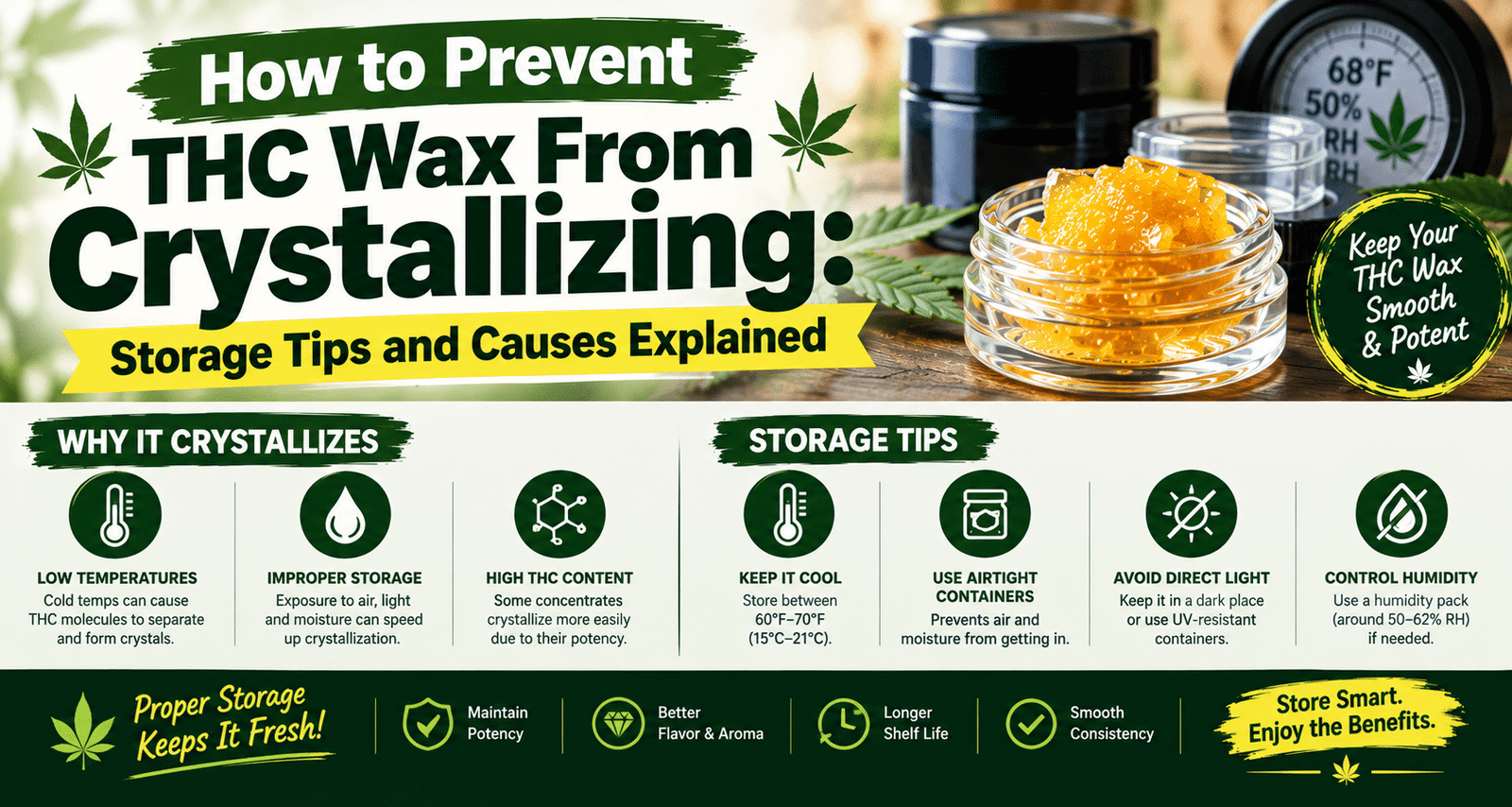
THC wax can change texture over time, sometimes becoming grainy, cloudy, gritty, or covered with small crystals. For people who prefer a smooth, soft, and easy-to-handle concentrate, these changes can be frustrating. Understanding how to prevent THC wax from crystallizing starts with knowing what causes the change and which storage practices help preserve the product’s original consistency.
THC wax crystallization occurs when certain cannabinoids, particularly THCA, organize into solid crystal structures within a concentrate. The process can be influenced by the extract’s composition, terpene content, temperature changes, and how the product was manufactured. Some concentrates are more likely to develop a crystalline texture than others, even when stored carefully.
It is also important to understand that crystallization is not automatically a sign of contamination or poor quality. Sugar wax, diamonds, and certain other concentrate textures naturally contain crystals. However, unexpected changes in appearance, smell, or consistency can indicate that a product needs closer inspection.
This guide explains how to reduce unwanted texture changes, store THC wax properly, recognize normal crystallization, and determine when a concentrate should no longer be used.
1. Understand Why THC Wax Crystallizes
The first step in preventing unwanted crystallization is understanding why it happens. THC wax is not a single, uniform substance. Depending on the product, it may contain cannabinoids, terpenes, and other naturally occurring compounds that influence its texture and stability.
What Causes THC Wax to Form Crystals?
Crystallization occurs when molecules arrange themselves into an organized solid structure. In cannabis concentrates, THCA can separate from the surrounding liquid phase and form visible crystals.
Several factors can influence this process.
Cannabinoid Concentration
Concentrates with high concentrations of certain cannabinoids may be more susceptible to crystal formation. When a cannabinoid is present in a mixture beyond what the liquid portion can consistently hold, crystals may develop over time.
Terpene Content
Terpenes are aromatic compounds that contribute to a concentrate’s smell, flavor, and physical characteristics. Their proportion relative to cannabinoids can influence whether an extract remains smooth, becomes grainy, or separates into crystals and liquid.
Product Formulation
Different concentrate textures are made using different processing and finishing methods. A product designed to develop THCA crystals will behave differently from a concentrate manufactured to maintain a uniform, whipped consistency.
Time and Storage Conditions
Even a concentrate that looks smooth when purchased can change during storage. Temperature fluctuations, exposure to air, and the natural properties of the extract may affect its consistency.
Is THC Wax Crystallization Always Bad?
No. Crystallization is a physical change, not automatically evidence that a concentrate has spoiled.
For example, sugar wax commonly has a grainy appearance, while diamonds and sauce intentionally combine solid crystals with a terpene-rich liquid. Some shatter can also develop a sugary texture over time.
The important distinction is between a normal texture change and signs of possible contamination, damaged packaging, or improper storage.
2. Store THC Wax at a Stable, Cool Temperature
Temperature management is one of the most useful steps for maintaining concentrate quality. However, it is important to avoid assuming that making a product colder will always stop crystallization. Temperature can influence crystal formation differently depending on the concentrate’s composition.
Avoid Frequent Temperature Changes
Repeated warming and cooling can affect the consistency of cannabis concentrates. Changes in temperature may alter how easily the material flows and how its different components interact.
To reduce unnecessary changes:
- Keep the container away from radiators, ovens, and other heat-producing appliances.
- Avoid leaving concentrates in direct sunlight.
- Do not leave THC wax in a hot vehicle.
- Choose a storage location with relatively consistent conditions.
- Avoid moving the product repeatedly between warm and cold environments.
These practices can help preserve the original texture and reduce unnecessary stress on the product.
Should THC Wax Be Refrigerated?
Refrigeration may help preserve certain concentrates, particularly terpene-rich products intended for longer storage. However, refrigeration is not a guaranteed way to prevent crystallization, and the appropriate conditions vary by product.
Follow the manufacturer’s storage instructions whenever they are available.
Let a Cold Container Reach Room Temperature Before Opening
When a refrigerated container is opened while still cold, moisture from the surrounding air can condense inside it. This introduces an avoidable source of moisture that may affect product quality.
If the manufacturer recommends refrigerated storage, allow the sealed container to return to the recommended handling temperature before opening it.
Avoid Freezing Unless the Manufacturer Recommends It
Freezing is not a universal solution for concentrate storage. It can introduce additional temperature changes and condensation risks during handling.
For ordinary consumer storage, following the product label is safer than experimenting with extreme temperatures to manipulate the wax’s texture.
3. Use an Airtight, Suitable Container
The container plays an important role in preserving THC wax. A poorly sealed container can allow greater exposure to air, moisture, odors, and environmental contaminants.
Although an airtight container cannot stop every natural crystallization process, it can help preserve the concentrate’s aroma, consistency, and overall condition.
Choose a Suitable Concentrate Jar
Glass containers designed for cannabis concentrates are commonly used because glass is generally non-reactive and can provide a good barrier when properly sealed.
Look for packaging that:
- Closes securely.
- Is compatible with cannabis concentrates.
- Does not leak or allow unnecessary air exchange.
- Protects the product from environmental contamination.
- Can be handled without damaging the seal.
The original packaging may be the best option when it is intact and designed for the product.
Keep the Container Closed Between Uses
Opening a container frequently increases exposure to air and the surrounding environment. Repeated handling can also introduce debris or moisture if the tools or work surface are not clean.
Practical Storage Habits
- Open the container only when necessary.
- Close the lid securely after handling.
- Use a clean, dry concentrate tool.
- Avoid touching the product directly with your fingers.
- Keep the container away from food, dust, and household contaminants.
Keep THC Wax Away From Direct Light
Direct sunlight and strong light exposure can contribute to changes in cannabis products over time. Heat from a sunny windowsill can create an additional problem.
Store the sealed container in a dark or opaque storage area, away from direct sunlight and heat sources.
These steps primarily help preserve overall product quality. They should not be treated as a guarantee that crystals will never form.
4. Choose the Right Concentrate and Handle It Carefully
Not all THC wax products are designed to maintain the same texture. Some are naturally smooth and whipped, while others are intentionally crystalline or contain both solid and liquid components.
Choosing a product suited to your preferred consistency can be more effective than trying to force a concentrate to behave differently from its intended formulation.
Understand the Difference Between Wax, Badder, Sugar, and Diamonds
Wax and Badder
Wax and badder generally have soft or scoopable consistencies, although the exact texture varies by producer and formulation. Badder is often whipped or worked into a creamy consistency.
These products may change texture during storage, and some can become grainy as their cannabinoid composition changes.
Sugar Wax
Sugar wax typically contains small crystals that give it a granular or wet-sugar appearance. Crystal formation is part of the texture rather than necessarily a defect.
Trying to eliminate every crystal from a product designed to have a sugary consistency may be unrealistic.
Diamonds and Sauce
Diamonds consist primarily of crystalline THCA, while sauce is a more liquid, terpene-rich portion of the concentrate. These components can naturally separate.
A jar containing crystals and liquid is therefore not automatically damaged or improperly stored.
Avoid Unapproved Heating or Chemical Additives
One common mistake is attempting to restore a concentrate’s original appearance by applying direct heat or adding substances to dissolve crystals.
Do not use a flame, household heating appliance, or improvised chemical treatment to alter THC wax.
Uncontrolled heating can degrade desirable compounds, create burn risks, and potentially damage the container. Adding unapproved substances can introduce contamination or change the product’s composition.
If the concentrate has changed unexpectedly, contact the licensed retailer or manufacturer for product-specific guidance instead of attempting to reformulate it at home.
Check the Product Before Purchasing
When buying concentrates from a lawful, regulated retailer, consider:
- The manufacturer’s recommended storage conditions.
- The product’s intended texture.
- The package seal and condition.
- Batch-specific laboratory testing, where available.
- Whether the appearance matches the product description.
A concentrate’s texture alone does not establish its potency, purity, or safety.
5. Recognize Normal Crystallization and Know When to Be Concerned
Even with careful storage, some THC wax will naturally develop crystals. The goal is to reduce avoidable changes and preserve quality, not to guarantee a permanently unchanged texture.
What Does Normal Crystallization Look Like?
Depending on the concentrate, ordinary crystallization may appear as:
- Small grains throughout the wax.
- A cloudy or sugary appearance.
- Firm crystalline particles within a softer material.
- Visible separation between crystals and a liquid layer.
These changes can occur because cannabinoids and terpenes behave differently within an extract.
Does Crystallized THC Wax Lose Potency?
Not necessarily. Crystal formation alone does not prove that a concentrate has lost potency. Crystallization can change how cannabinoids are distributed between the solid and liquid portions without automatically indicating that the entire product has degraded.
However, texture cannot reliably establish potency. Only appropriate testing can determine the product’s cannabinoid content.
When Should You Avoid Using THC Wax?
Crystallization by itself is not sufficient evidence that a concentrate is unsafe. Look for additional warning signs, including:
- Visible mold or unusual biological growth.
- Unexpected foreign particles.
- A damaged seal or evidence of tampering.
- An unusual odor that differs substantially from the expected product profile.
- Signs that the product has been contaminated or stored improperly.
If you suspect contamination, do not consume the concentrate. Contact the retailer or manufacturer, and follow any applicable product recall or safety guidance.
A Simple THC Wax Storage Checklist
Before putting a concentrate away, check the following:
- The container is appropriate for the product and closes securely.
- The storage area is cool, dark, and away from heat sources.
- The product is protected from moisture and environmental contaminants.
- Temperature changes are minimized.
- The manufacturer’s instructions are followed.
- The concentrate’s appearance and packaging are checked periodically.
This routine helps protect product quality while recognizing that some texture changes are a natural characteristic of cannabis extracts.
Frequently Asked Questions About Preventing THC Wax From Crystallizing
Can You Completely Stop THC Wax From Crystallizing?
No. Some concentrates naturally form crystals because of their cannabinoid composition and formulation. Proper storage can help preserve quality and reduce avoidable changes, but it cannot guarantee that crystallization will never occur.
Does Putting THC Wax in the Refrigerator Prevent Crystallization?
Not reliably. Refrigeration may help preserve certain products, but temperature also influences crystallization. Follow the manufacturer’s instructions rather than assuming colder storage is always better.
Why Did My THC Wax Turn Into Sugar?
Your concentrate may have undergone crystallization, in which cannabinoids form small solid structures within the extract. This can be a natural texture change, particularly in products that contain crystallization-prone cannabinoids.
Is Crystallized THC Wax Still Good?
Crystallization alone does not mean the product has spoiled. Check its packaging, storage history, odor, and appearance. If you suspect contamination or cannot establish that the product has been stored safely, do not use it.
Should I Stir THC Wax to Prevent Crystallization?
Stirring is not a universal solution. Agitation may change how crystals are distributed, but it does not necessarily prevent them from forming. Follow the manufacturer’s handling recommendations.
Does Crystallization Mean THC Wax Is Fake?
No. Crystals can develop naturally in genuine cannabis concentrates. Appearance alone cannot establish whether a product is authentic, pure, or correctly labeled.
Conclusion
Preventing THC wax from crystallizing begins with understanding the product’s composition and intended texture. Cannabinoid concentration, terpene content, manufacturing methods, time, and storage conditions can all influence whether a concentrate remains smooth or develops crystals.
For consumers, the most practical approach is to use suitable airtight packaging, minimize temperature fluctuations, protect the product from heat and light, avoid moisture, and follow the manufacturer’s storage instructions.
It is equally important to recognize that crystallization is not always a problem. Sugar wax and diamonds naturally contain crystals, and other concentrates can develop a grainy appearance as their components change over time.
Rather than attempting to eliminate every crystal with uncontrolled heating or additives, focus on preserving the product as intended and checking for signs of contamination or damage. This approach helps protect concentrate quality without confusing a normal physical change with a safety problem.
This article is for educational purposes only. Cannabis laws vary by jurisdiction, and THC concentrates should be handled and stored securely away from children and pets.