
Blog/News
Will THC Wax Show Up on a Drug Test? THC Wax Detection Times Explained

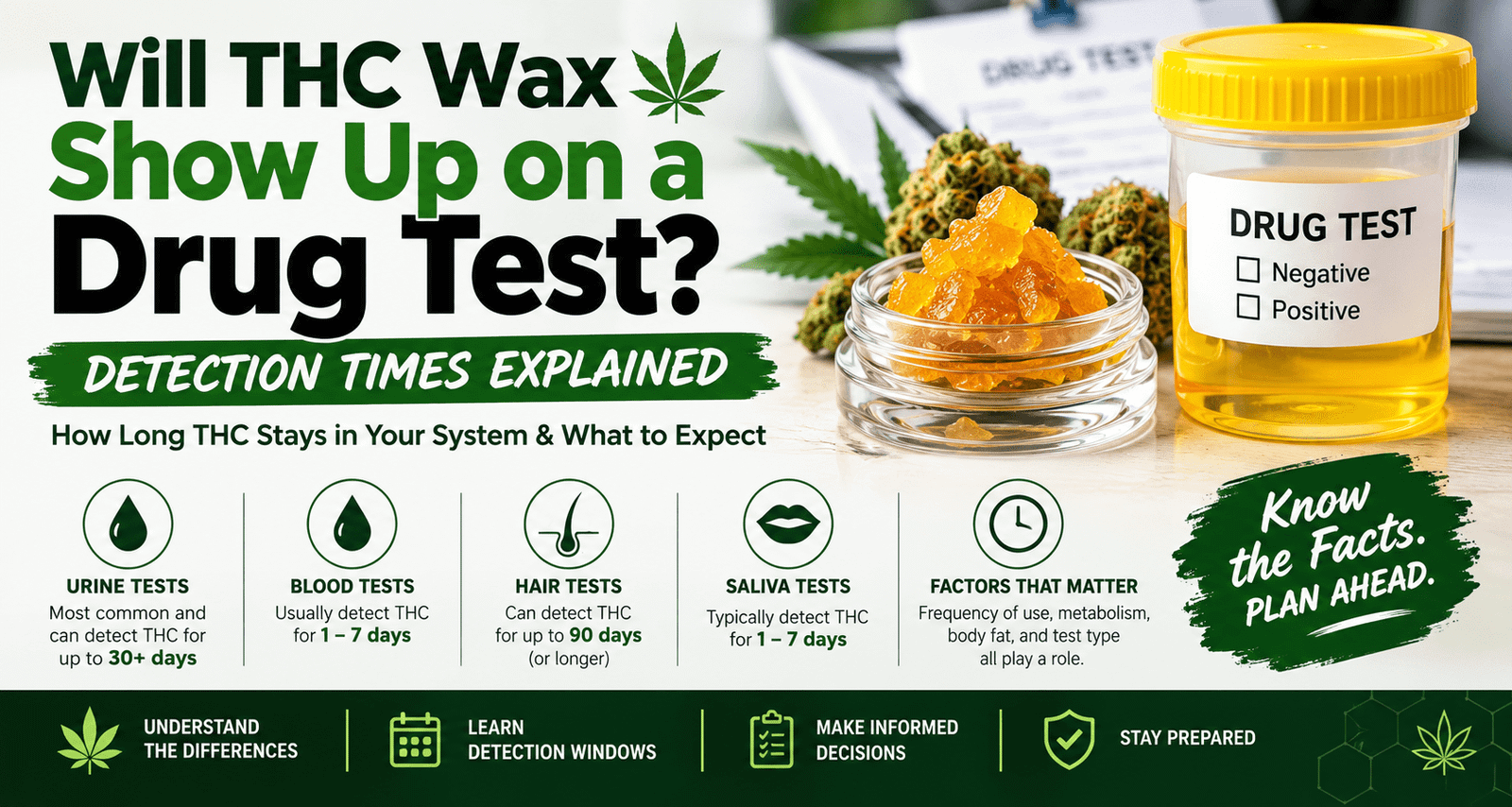
Yes, THC wax can show up on a drug test. THC wax, sometimes called cannabis wax, marijuana wax, dabs, or cannabis concentrate, contains concentrated cannabinoids, including THC. When you use THC wax, your body processes THC and produces metabolites that can remain detectable after the noticeable effects have worn off.
Most drug tests are not designed to determine whether someone used wax, flower, vape oil, or another form of cannabis. Instead, the test looks for specific cannabis compounds or metabolites in a biological sample. Urine testing commonly targets 11-nor-9-carboxy-delta-9-tetrahydrocannabinol, commonly called THC-COOH.
This means someone can feel completely normal and still receive a positive marijuana drug-test result.
The length of time THC wax remains detectable depends on several variables, including how much was used, how often cannabis is used, the type of test, the laboratory cutoff, and individual differences in metabolism and THC storage.
There is therefore no single number of days that guarantees a negative test.
Can THC Wax Show Up on a Drug Test?
Yes. THC wax can trigger a positive cannabis drug test.
THC wax is a cannabis concentrate. Once THC enters the body, it is metabolized into several compounds. Urine marijuana tests commonly detect THC-COOH rather than the intoxicating THC molecule itself.
Why Does THC Wax Show Up?
Drug testing does not necessarily care whether THC came from:
- Cannabis flower
- THC wax
- Dabs
- Vape cartridges
- Cannabis oils
- Other THC-containing products
If the product introduces enough THC into the body, its metabolites may become detectable.
Does a Test Know You Used Wax?
Usually, no.
A standard cannabis test generally cannot tell the difference between THC exposure from wax and THC exposure from another cannabis product.
The test result indicates exposure to cannabis-related THC metabolites rather than identifying the exact product or route of administration. The American College of Medical Toxicology notes that urine THC-metabolite testing cannot determine the route of exposure, exact timing, dose, or impairment.
The Simple Answer
If you used THC wax and then take a drug test that includes cannabis, there is a possibility of testing positive.
The risk depends heavily on your pattern of use and the type of test.
How Long Does THC Wax Stay in Your System?
There is no universal detection period for THC wax.
For urine testing, Mayo Clinic Laboratories gives approximate THC-COOH detection periods of up to 3 days after single use, about 5 days with moderate use, around 10 days with daily heavy use, and up to approximately 30 days with chronic heavy use. These are estimates, not guaranteed timelines.
Other laboratory guidance notes that chronic heavy cannabis use can sometimes result in urinary THC-COOH detection for 30 to 60 days after use stops.
Approximate Urine Detection Windows
| Cannabis-use pattern | Approximate urine detection |
|---|---|
| One-time use | Around several days |
| Occasional use | Several days or potentially longer |
| Moderate/frequent use | Around several days to more than a week |
| Daily heavy use | Around 10 days or longer |
| Chronic heavy use | Around 30 days or potentially substantially longer |
These ranges should be treated as estimates rather than promises.
Why Can Wax Be Different?
Wax is a concentrate, meaning a relatively small amount of product can contain a substantial amount of THC.
The amount of THC absorbed can therefore differ significantly from one person’s experience to another.
Does One Dab Guarantee a Positive Test?
No.
Likewise, one dab does not guarantee a negative result.
Controlled research has demonstrated that urinary THC-metabolite concentrations and detection results can vary after smoked versus vaporized cannabis exposure.
Detection Is Individual
Two people can use similar amounts of THC and receive different test results because their bodies process and eliminate cannabinoids differently.
What Does a THC Drug Test Actually Detect?
A common misconception is that a urine test simply looks for active THC.
That is usually not the case.
THC vs. THC-COOH
THC is the primary psychoactive cannabinoid responsible for the intoxicating effects of cannabis.
THC-COOH is a major inactive metabolite produced when the body processes THC.
Many urine cannabis tests are designed to detect THC-COOH.
Why Does THC-COOH Last Longer?
THC itself leaves the bloodstream relatively quickly compared with its metabolites.
Mayo Clinic Laboratories notes that the parent THC compound has a clearance half-life of less than 30 minutes in the context of its urine-testing explanation, while THC-COOH can remain detectable for substantially longer.
Does a Positive Test Mean You Are High?
No.
A positive urine THC-metabolite result does not establish that someone is currently intoxicated or impaired.
The American College of Medical Toxicology specifically states that urine THC-metabolite testing cannot determine impairment.
Drug Testing Measures Exposure, Not Necessarily Intoxication
This distinction is important:
Positive THC-metabolite test: Indicates detectable cannabis exposure.
Currently intoxicated: Cannot be established simply from a urine THC-metabolite result.
Exact time of use: Cannot reliably be determined from a standard urine result alone.
Can THC Wax Show Up on a Urine Test?
Yes. Urine is one of the most common samples used for cannabis drug testing, and THC wax use can produce detectable THC metabolites in urine.
Urine testing is widely used in workplace and clinical drug-testing settings. MedlinePlus identifies marijuana/cannabis/THC among substances that can be tested through urine and other biological samples.
How Long Can Wax Be Detected in Urine?
The answer varies substantially.
A single exposure may result in detection for several days, while frequent or chronic use can extend the detection window considerably. Mayo Clinic Laboratories estimates approximately 3 days after single use and up to approximately 30 days for chronic heavy use, while other laboratory guidance reports that chronic users can sometimes remain positive for 30 to 60 days.
What Can Affect a Urine Result?
Factors include:
- Frequency of cannabis use
- Amount of THC consumed
- Time since the last exposure
- Individual metabolism
- Body composition
- Hydration
- Laboratory cutoff
- Testing methodology
The American College of Medical Toxicology notes that urine THC-metabolite concentrations can be affected by exposure history, time since use, hydration, and individual characteristics.
What Are Common Urine Testing Cutoffs?
Federal workplace testing uses established cutoff concentrations. SAMHSA’s clinical drug-testing guidance identifies 50 ng/mL as a common initial urine cannabinoid screening cutoff and 15 ng/mL for confirmatory testing of the THC metabolite.
Why Cutoffs Matter
A laboratory does not simply ask:
“Is any THC molecule present?”
Instead, testing generally uses established analytical thresholds.
A person’s result can therefore depend partly on the testing method and cutoff used.
Will THC Wax Show Up on a Saliva Test?
Yes. THC exposure from wax can potentially be detected through an oral-fluid or saliva test.
Saliva testing is different from urine testing because the biological sample and detection characteristics are different.
How Does Saliva Testing Work?
A saliva test collects oral fluid using a swab placed in the mouth.
Drug testing can use saliva, urine, blood, hair, sweat, and other specimens depending on the testing program.
Is Saliva Detection Shorter Than Urine?
Generally, oral-fluid testing is more oriented toward relatively recent exposure than urine testing.
Urine can remain positive long after the effects of cannabis have ended because it measures metabolites that persist in the body.
Can a Saliva Test Tell You Used Wax?
A standard test generally does not identify “wax” as the specific cannabis product.
Instead, it detects the cannabinoid target included in the testing panel.
Saliva and Urine Are Different
Think of the tests this way:
Urine: Often detects THC metabolites and can remain positive for a longer period.
Saliva: More closely associated with recent exposure.
Blood: Generally has a shorter detection window than urine.
Hair: Can provide a longer historical window but has limitations for very recent or occasional use.
Will THC Wax Show Up on a Hair Test?
THC exposure can potentially be detected through hair testing.
Hair testing works differently from urine and saliva testing.
How Does Hair Testing Detect Cannabis?
Drug-related compounds can become incorporated into growing hair.
SAMHSA explains that hair testing can detect drug metabolites and that hair grows at approximately 1 centimeter per month, although the timing of drug incorporation and detection has important limitations.
How Far Back Can Hair Testing Look?
Hair testing is generally used to examine a longer historical period than urine or saliva testing.
However, hair is not ideal for detecting very recent cannabis use.
SAMHSA materials note that drug metabolites may become detectable in hair approximately 7 to 10 days after ingestion, meaning hair testing should not be interpreted as an immediate-use test.
Can Hair Testing Identify a Single Use?
Hair testing has limitations when it comes to occasional or isolated cannabis exposure.
It is generally more useful for identifying patterns of historical exposure than determining very recent consumption.
Hair Testing Has Important Limitations
Hair results can be influenced by:
- Hair growth
- Cosmetic treatment
- External contamination
- Sample characteristics
- Testing methodology
Therefore, a hair result should not automatically be interpreted as an exact record of when someone used cannabis.
Does THC Wax Stay Longer Than Marijuana Flower?
It can, but there is no simple rule that says wax will always remain detectable longer than flower.
The important factor is THC exposure, not simply the physical form of cannabis.
Why Wax Can Produce More THC Exposure
Cannabis concentrates are designed to contain concentrated cannabinoids.
A person may therefore consume a substantially larger amount of THC from a small quantity of concentrate than from a comparable amount of raw flower.
Does More THC Mean a Longer Detection Window?
Greater exposure can contribute to greater metabolite concentrations, but it does not allow anyone to calculate an exact detection period.
Frequency of use is particularly important because repeated cannabis exposure can lead to accumulation of THC and metabolites in the body.
What Does Research Show?
Research comparing vaporized and smoked cannabis has demonstrated differences in urinary THC-metabolite concentrations and detection results.
This reinforces an important point:
Route, dose, frequency, and individual factors can all influence test results.
Wax Is Not a Special Drug-Test Category
A laboratory generally does not report:
“THC wax detected.”
Instead, a cannabis-related analyte or metabolite is reported according to the testing method.
What Factors Affect How Long THC Wax Is Detectable?
Several variables can affect cannabis detection.
Frequency of Use
This is one of the most important factors.
Someone who uses cannabis once may have a very different detection window from someone who uses THC concentrates every day.
Amount of THC Used
A higher THC exposure can produce higher concentrations of metabolites.
This does not translate into a precise number of additional days, however.
Metabolism
Individual metabolism varies.
Two people with similar cannabis-use histories may eliminate THC metabolites at different rates.
Body Composition
THC is highly lipid soluble, and THC stored in fatty tissue can gradually reenter circulation and undergo further metabolism.
Hydration
Urine concentration can affect measured metabolite concentrations.
The American College of Medical Toxicology notes that hydration status can influence urine THC-metabolite concentrations.
Testing Method
A urine test, saliva test, blood test, and hair test can produce very different detection windows.
Laboratory Cutoff
A test result depends partly on the threshold used by the laboratory.
Federal workplace programs, for example, use defined screening and confirmation cutoffs for cannabis metabolites.
Why Nobody Can Guarantee an Exact Date
Because all of these variables interact, statements such as:
“Wax leaves your system in exactly 7 days”
are not scientifically reliable.
A better answer is that THC detection varies by person, exposure, specimen type, and testing method.
Can You Test Positive for THC After You Stop Feeling High?
Yes.
This is one of the most important facts about cannabis drug testing.
The psychoactive effects of THC generally last much less time than the period during which THC metabolites can remain detectable.
Why Does This Happen?
The body processes THC into metabolites, including THC-COOH.
These metabolites can remain detectable after the noticeable effects of cannabis have disappeared.
Does a Positive Test Prove Recent Use?
Not necessarily.
A positive urine THC-metabolite test indicates exposure before the sample was collected, but it cannot reliably establish the exact time of use.
The American College of Medical Toxicology specifically notes that urine THC testing cannot identify the precise timing of exposure.
Can You Be Sober and Still Test Positive?
Yes.
A person can feel completely sober and still have detectable THC metabolites.
Detection Is Not the Same as Impairment
This distinction is especially important for workplace, medical, legal, and safety discussions.
Drug test: Detects a target compound or metabolite.
Impairment assessment: Evaluates whether someone is currently affected.
These are not interchangeable measurements.
Can Drinking Water or Detox Products Guarantee a Negative THC Test?
No reliable method can guarantee that a person will receive a negative THC drug-test result by a particular time.
Commercial “detox” products often make claims that go beyond what drug-testing science can establish.
Why Is Detox Timing Difficult to Predict?
THC metabolites are affected by multiple biological and testing variables.
There is no scientifically reliable countdown clock that works identically for everyone.
Does Drinking Excessive Water Remove THC?
Drinking excessive amounts of water does not simply remove stored THC from the body.
It can also create a highly diluted urine specimen, which may be identified through specimen-validity testing.
SAMHSA’s drug-testing resources specifically describe urine specimen-validity testing as part of federal workplace testing programs.
Can Exercise Guarantee a Negative Result?
No.
Exercise should not be treated as a guaranteed way to eliminate THC metabolites before testing.
Do Detox Drinks Guarantee a Negative Test?
No.
A product marketed as a “THC detox” cannot guarantee a negative laboratory result.
The Safest Scientific Answer
If a drug test matters for employment, treatment, legal proceedings, athletics, or another important purpose, the most reliable approach is to understand the testing requirements and recognize that individual detection windows cannot be predicted with certainty.
THC Wax Drug Test FAQs: What You Need to Know
Will one hit of THC wax show up on a drug test?
It can.
A single cannabis exposure may produce detectable THC metabolites, although whether a particular test is positive depends on dose, timing, individual factors, and the test’s cutoff.
How long does THC wax stay in urine?
There is no universal timeframe. Mayo Clinic Laboratories gives an approximate range of up to 3 days after single use and longer periods with frequent or chronic use. Chronic heavy use may result in detection for 30 days or longer.
Can wax make you fail a urine drug test?
Yes.
If enough THC metabolites remain above the laboratory’s reporting threshold, a urine cannabis test can be positive.
Is THC wax stronger than regular marijuana?
THC wax is a cannabis concentrate and can contain substantially more concentrated THC than typical cannabis flower. The actual potency varies by product.
Does a drug test detect wax specifically?
Usually no.
A standard cannabis test generally detects THC or its metabolites rather than identifying whether the THC came from wax, flower, or another cannabis product.
Will a 50-ng/mL urine test detect THC wax?
It can.
A 50 ng/mL cutoff is commonly used for initial cannabinoid screening in federal workplace testing. Whether a particular wax exposure produces a result above that cutoff depends on the individual’s exposure and other factors.
Can THC wax show up on a saliva test?
Yes.
Cannabis exposure can be assessed using oral-fluid testing, although its detection characteristics differ from urine testing.
Can THC wax show up on a hair test?
Yes, cannabis exposure can potentially be detected through hair analysis, although hair testing has limitations and is not ideal for detecting very recent use.
Can you test positive for THC after the high is gone?
Yes.
THC metabolites can remain detectable after the intoxicating effects have ended.
Does a positive THC test mean you are currently high?
No.
A urine THC-metabolite result cannot establish current impairment.
Can THC wax stay in your system for 30 days?
It can, particularly with frequent or chronic cannabis use. Some laboratory guidance reports detection for 30 days or longer in chronic heavy users.
Can THC wax be detected for 60 days?
In some chronic heavy users, urinary THC metabolites may remain detectable for 30 to 60 days after cannabis use stops. This is not a universal timeframe and should not be interpreted as a guarantee.
Does CBD cause a positive THC test?
Pure CBD itself does not metabolize into THC-COOH according to the American College of Medical Toxicology. However, some products marketed as CBD can contain enough THC to potentially produce a positive THC-metabolite result.
Does vaping THC show up on a drug test?
Yes.
Vaporized cannabis can produce detectable THC metabolites. Research has demonstrated measurable urinary THC-COOH after vaporized cannabis exposure.
Is THC wax the same as marijuana for drug testing?
For a standard cannabis drug test, the distinction generally does not matter. The test is typically looking for THC or its metabolites rather than the specific cannabis product used.
What is the most common drug test for marijuana?
Urine is the most commonly used specimen for drug testing, although saliva, blood, hair, and other specimens can also be used.
Final Answer: Will THC Wax Show Up on a Drug Test?
Yes. THC wax can show up on a drug test.
THC wax is a concentrated cannabis product, and the THC it contains is metabolized by the body. Many cannabis drug tests—particularly urine tests—look for the THC metabolite THC-COOH rather than the intoxicating THC molecule itself.
The important point is that a drug test usually cannot tell that you used “wax.” It generally identifies cannabis-related THC exposure.
THC wax detection in simple terms
Urine test: THC metabolites can remain detectable for several days after occasional use and substantially longer with frequent or chronic use.
Saliva test: Generally focuses on more recent cannabis exposure.
Blood test: Usually has a shorter detection window than urine.
Hair test: Can provide information about historical exposure but is not well suited to detecting very recent use.
For urine testing, Mayo Clinic Laboratories estimates approximately 3 days after single use, 5 days with moderate use, 10 days with daily heavy use, and up to 30 days with chronic heavy use, while some laboratory guidance reports that chronic heavy users may remain detectable for 30 to 60 days.
These numbers are not guarantees.
The actual result can be influenced by the amount of THC used, how frequently cannabis is consumed, individual metabolism, body composition, hydration, the time between use and testing, and the laboratory’s testing method and cutoff.
Another crucial distinction is that testing positive is not the same as being impaired. A urine THC-metabolite test can indicate previous exposure without proving that someone is currently high or impaired.
The bottom line
Yes, THC wax can cause a positive drug test. The fact that wax is a concentrate can mean substantial THC exposure, but no exact detection period applies to everyone.
If a drug test is important for employment, medical care, athletics, legal proceedings, or another formal purpose, do not rely on a specific “number of days” as a guarantee of a negative result. Drug-testing windows are estimates, and laboratory results depend on the individual and the test used.
This article is for general educational purposes and is not medical or legal advice.