
Blog/News
What THC Edible is Best for Sleep? The Science of Cannabinoids and Sleep Cycles

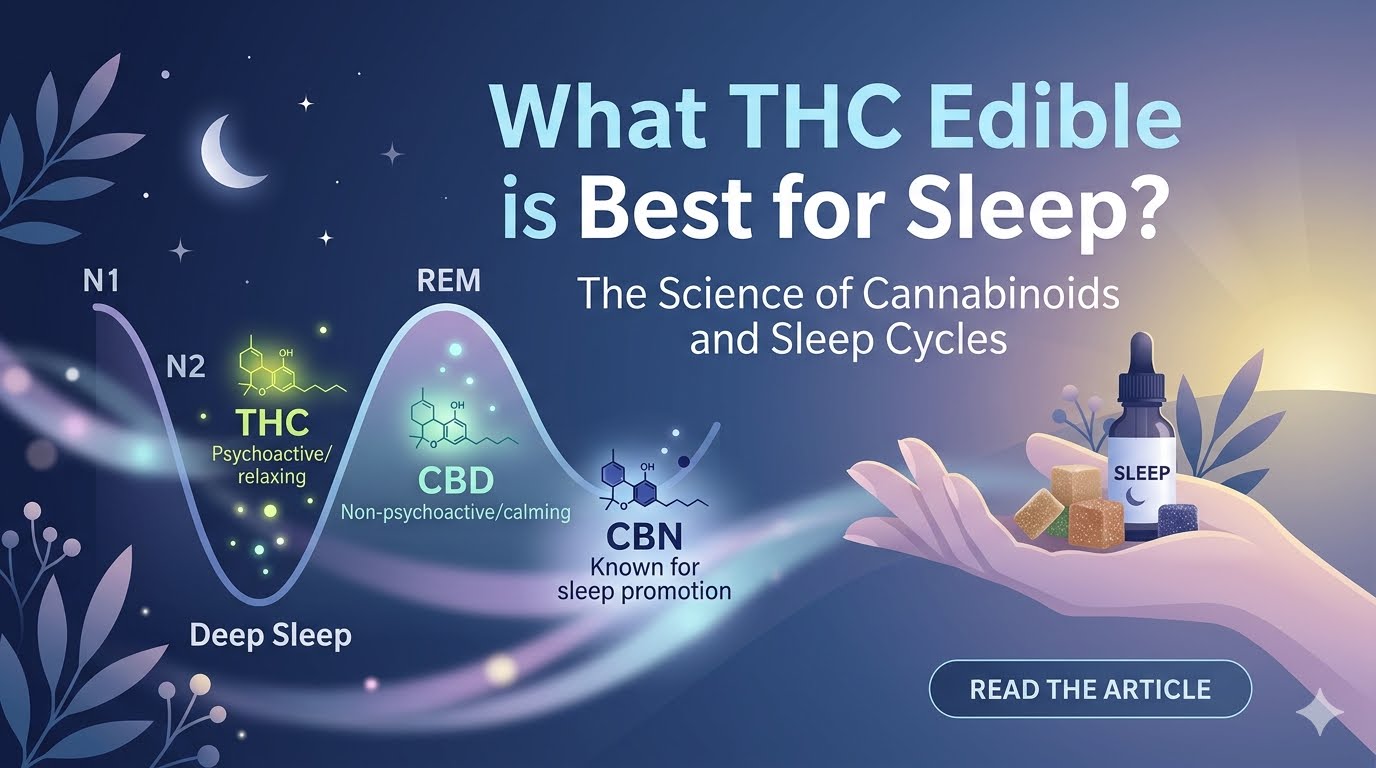
What THC edible is best for sleep?
The best THC edible for sleep is not a high-dose pure THC product, but rather a balanced, multi-cannabinoid formulation pairing low-dose Tetrahydrocannabinol (THC) with Cannabinol (CBN) and Cannabidiol (CBD). While pure THC acts as an initial sedative that reduces the time it takes to fall asleep, clinical insights demonstrate that combining it with secondary cannabinoids creates a synergistic “entourage effect”. This approach optimizes sleep maintenance throughout the night without causing next-day grogginess or disrupting critical sleep architecture.
For individuals looking to buy or formulate targeted cannabis products, understanding the interactions between cannabinoids, terpenes, and the human digestive tract is essential. This document outlines the biochemical frameworks, general strategies, and leading product standards used in modern cannabinoid science to promote restful sleep.
The Cannabinoid Matrix for Sleep
Different cannabis compounds target distinct aspects of the human nervous system. Relying solely on a single cannabinoid reduces overall efficacy.
1. THC (Tetrahydrocannabinol): The Sleep Inducer
THC interacts directly with CB1 receptors in the body’s endocannabinoid system to induce drowsiness and shorten sleep latency (the time it takes to fall asleep). However, high doses of pure THC can trigger a elevated heart rate, spike pre-sleep anxiety, and significantly suppress REM (Rapid Eye Movement) sleep, which is critical for cognitive processing.
2. CBN (Cannabinol): The Sedative Heavyweight
CBN is a non-intoxicating cannabinoid created when THC breaks down or ages over time. Research shows that CBN reduces the body’s arousal threshold, effectively minimizing nighttime awakenings and extending total sleep duration.
3. CBD (Cannabidiol): The Anxiolytic Stabilizer
CBD does not possess direct sedative qualities, but it plays a crucial role by mitigating anxiety, lowering body temperature, and easing chronic physical discomfort. Furthermore, CBD smooths out the psychoactive “come-up” of THC, preventing late-night panic or intense dreaming cycles.
Expert-Recommended Cannabinoid Ratios
When searching state-regulated dispensaries, focus on balanced mathematical ratios rather than broad marketing claims. The most effective formulations fall into three distinct structural profiles:
| Edible Ratio Type | Target User Profile | Key Biological Benefit |
|---|---|---|
| 1:1:1 Balanced Ratio (e.g., THC : CBD : CBN) | Users with high stress, muscle tension, or moderate cannabis tolerance. | Addresses systemic pain and mental anxiety simultaneously to ensure deep sleep maintenance. |
| Low-THC, High-CBN Profile (e.g., Low THC : High CBD : Moderate CBN) | Beginners, seniors, or individuals sensitive to psychoactive effects. | Calms a racing mind and relaxes the physical body safely without inducing next-morning brain fog. |
| Fast-Acting Nano-Edibles (Utilizing water-soluble emulsion technology) | Users who struggle with sleep onset and need immediate relief. | Bypasses traditional liver metabolism to deliver active compounds within 15–20 minutes instead of hours. |
Highly Rated Industry Standards for Sleep
Several leading cannabis brands utilize these exact ratios to create functional, data-backed sleep products:
- Wyld CBD & THC Sleep Gummies: Celebrated for their precision-dosed elderberry and dark cherry options, these gummies pair a gentle dose of THC with higher levels of CBD and CBN to ease the body into deep rest without a sudden psychological crash.
- Kiva Camino Sleep Gummies: Formulations like Midnight Blueberry and Blackberry Dream blend specific cannabinoids with natural, calming plant extracts like chamomile and lavender to enhance the sedative effect.
- CBDfx Nighttime THC Gummies: A highly reputable, federally legal hemp-derived option that delivers a consistent ratio of clean THC to broad-spectrum CBD, entirely free of synthetic chemical solvents.
Actionable Guidelines for Safe Consumption
Because ingested cannabis must pass through the gastrointestinal tract and liver, it behaves differently than inhaled options:
- Mind the Absorption Gap: Standard edibles take roughly 60 to 90 minutes to become active in the bloodstream. To ensure alignment with your natural circadian rhythm, consume your sleep edible roughly one to two hours before your target bedtime.
- Start Low and Go Slow: If you are new to cannabinoids, start with a minimal dose of THC. Increase the dosage incrementally every few nights until you achieve steady sleep without next-day grogginess.
- Verify Third-Party Lab Testing: Always ensure your chosen products feature a verifiable Certificate of Analysis (COA) to confirm accurate dosing and ensure the formula is free of pesticides and heavy metals.