
Blog/News
THC Wax Consistency Guide: Live, Budder, Shatter Explained

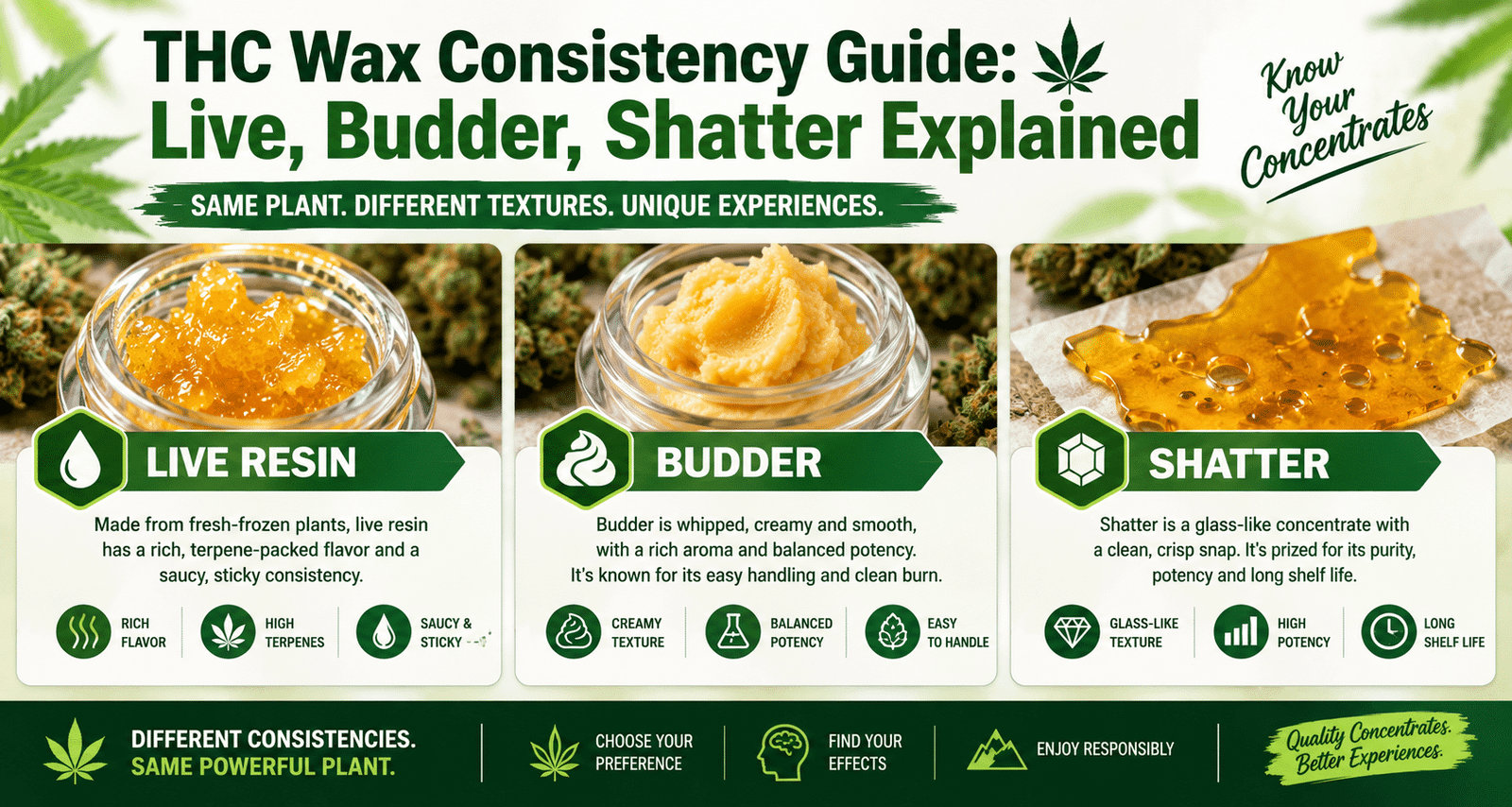
THC Wax Consistency Guide: THC wax is not one single type of cannabis concentrate. The word “wax” is often used as a broad description for concentrated cannabis extracts, but these products can have very different textures, appearances, aromas, and handling characteristics.
A concentrate may be soft and creamy, firm and glass-like, sticky and crumbly, or glossy and easy to manipulate. These differences are largely connected to extraction methods, processing conditions, cannabinoid and terpene content, and the way the extract is handled after production.
Three names that frequently appear when people compare concentrate consistency are live resin, budder, and shatter. Although all three can contain high concentrations of THC, their physical characteristics can be dramatically different.
Understanding consistency can make concentrate terminology much easier to navigate. It can also help explain why two products with similar THC percentages may look and behave completely differently.
This guide breaks down the major characteristics of live resin, budder, and shatter, explains how their textures differ, and shows what terms such as “sugar,” “crumble,” and “wax” usually mean.
What Determines THC Wax Consistency?
THC concentrate consistency is not determined by THC percentage alone. A product’s texture develops from a combination of the cannabis material used, extraction process, post-extraction handling, temperature, terpene concentration, and crystallization behavior.
The Role of Extraction
Different extraction and refinement techniques can produce different physical structures.
The starting material matters as well. Fresh-frozen cannabis, dried cannabis, and other forms of plant material can produce concentrates with noticeably different characteristics.
Fresh-Frozen Cannabis
Fresh-frozen cannabis is commonly associated with live resin and other live-extract products.
Freezing the plant soon after harvest helps preserve volatile compounds that can otherwise be lost during drying and curing.
The resulting concentrate can have a strong aroma and a soft, sticky, or sauce-like consistency depending on how it is processed.
The Role of Terpenes
Terpenes are aromatic compounds naturally found in cannabis and many other plants.
A concentrate containing more terpene-rich material may remain softer or more fluid than a highly refined concentrate with fewer volatile compounds.
This is one reason two extracts with similar THC levels can have completely different textures.
Temperature Changes Texture
Temperature has a major effect on concentrate consistency.
When Concentrates Are Cold
Many concentrates become firmer when exposed to lower temperatures.
A soft product can become noticeably harder, while a glass-like concentrate may become more brittle.
When Concentrates Are Warm
Heat generally makes many concentrates softer.
A solid or semi-solid extract may become sticky, glossy, or easier to manipulate as its temperature rises.
This does not mean concentrates should be exposed to excessive heat. High temperatures can accelerate degradation and may alter aroma and texture.
Processing Also Matters
Post-extraction processing can dramatically change the physical appearance of a concentrate.
An extract can potentially be processed into forms such as:
- Shatter
- Budder
- Wax
- Crumble
- Sugar
- Sauce
These names describe physical characteristics, although industry terminology is not always standardized.
Live Resin vs Budder vs Shatter
Live resin, budder, and shatter are often grouped together because they are cannabis concentrates, but their consistency can be very different.
What Is Live Resin?
Live resin is a cannabis concentrate commonly produced from fresh-frozen cannabis rather than conventionally dried and cured flower.
Its defining feature is generally associated with preserving a broader portion of the plant’s volatile compounds.
Live Resin Texture
Live resin does not have one universal consistency.
Depending on processing, it may appear:
- Sticky
- Glossy
- Saucy
- Semi-liquid
- Thick and syrup-like
- Soft and malleable
Some live resin products may resemble traditional wax, while others can look considerably more fluid.
Why Live Resin Can Look Wet
The appearance of live resin can be influenced by its terpene content and processing.
A terpene-rich concentrate may have a glossy or fluid appearance.
This does not automatically indicate that the product is lower quality.
What Is Budder?
Budder is a concentrate known for its soft, creamy, whipped, or buttery consistency.
The name comes from its texture rather than from the presence of dairy or butter.
Budder Texture
A typical budder may resemble:
- Soft butter
- Whipped frosting
- Thick cream
- Soft clay
It is generally easier to manipulate than a hard, glass-like concentrate.
Why Is Budder Soft?
Budder’s texture is influenced by the way the concentrate is processed after extraction.
Agitation, temperature control, and other processing conditions can encourage a softer, aerated structure.
The exact process varies among producers.
What Is Shatter?
Shatter is a concentrate recognized for its hard, translucent, glass-like appearance.
It can be relatively firm at room temperature and may break or “shatter” when handled, which is where the name comes from.
Shatter Texture
Shatter is generally:
- Firm
- Smooth
- Glass-like
- Brittle
- Sometimes translucent
Its texture can change with temperature and storage conditions.
Why Does Shatter Break?
The physical structure of shatter allows it to behave more like a brittle solid than a soft wax.
Cold temperatures can make it particularly rigid.
As it warms, it may become more flexible and sticky.
Quick Consistency Comparison
| Concentrate | Typical consistency | Appearance | Handling |
|---|---|---|---|
| Live resin | Sticky, saucy, soft, or semi-fluid | Glossy or terpene-rich | Often soft and sticky |
| Budder | Creamy and soft | Opaque, buttery | Generally easy to manipulate |
| Shatter | Hard and brittle | Glass-like, translucent | Breaks into pieces |
These are general descriptions rather than strict rules. Processing techniques can produce products that fall somewhere between traditional categories.
How Do Wax, Crumble, Sugar, and Sauce Compare?
The word wax is frequently used as an umbrella term, but concentrate terminology can be inconsistent between producers, retailers, and consumers.
What Is Cannabis Wax?
Cannabis wax generally refers to a concentrated cannabis extract with a soft, waxy, sticky, or semi-solid texture.
The consistency can range from creamy to crumbly.
Why Does Wax Look Different From Batch to Batch?
Variations can result from:
- Starting material
- Extraction technique
- Purification
- Terpene content
- Temperature
- Agitation
- Storage
- Age
Therefore, the word “wax” alone does not describe every physical characteristic of a product.
What Is Crumble?
Crumble is a concentrate with a dry, crumbly texture.
It may break apart relatively easily instead of behaving like sticky wax.
Crumble Texture
Crumble can resemble:
- Dry honeycomb
- Soft chalk
- Crumbly candy
- Dry wax
Its relatively dry structure can make it visually distinct from budder or sauce.
What Is Cannabis Sugar?
Sugar generally describes a concentrate containing small crystalline structures that create a texture resembling wet or granular sugar.
It can range from relatively dry to somewhat sticky.
Why Does Sugar Look Crystalline?
Cannabinoids can form crystalline structures under certain processing conditions.
The result can be a concentrate with visible granules rather than a completely smooth texture.
What Is Sauce?
Sauce is usually associated with a highly terpene-rich, viscous concentrate.
It can look wet, glossy, or syrup-like.
Sauce vs Shatter
The contrast is easy to understand:
Sauce: soft, wet, fluid, or semi-fluid.
Shatter: firm, rigid, and glass-like.
Both can contain substantial cannabinoid concentrations, but their physical properties are very different.
Is Wax the Same as Shatter?
Not necessarily.
“Wax” usually suggests a softer consistency, while “shatter” describes a firmer, glass-like structure.
However, concentrate naming conventions are not perfectly standardized, so appearance and consistency can overlap.
How to Choose a THC Wax Consistency?
Choosing between concentrate consistencies is largely about understanding what physical characteristics you prefer.
Choose Based on Texture
If you prefer a soft, creamy concentrate, budder may be the consistency most closely associated with that preference.
If you prefer a firm, glass-like product, shatter has that characteristic.
If aroma and a terpene-rich profile are important considerations, live resin is commonly associated with preserving more of the plant’s volatile compounds.
Texture Is Not the Same as Potency
A common mistake is assuming that a harder concentrate must be stronger.
That is not necessarily true.
Consistency describes the physical structure of the concentrate. THC potency describes cannabinoid concentration.
A soft product can have high THC content, while a hard product can have a different cannabinoid profile.
Consider Handling
Different consistencies behave differently during storage and handling.
Soft Concentrates
Soft concentrates may be easier to manipulate but can become sticky when warm.
Hard Concentrates
Shatter-style concentrates can be easier to portion into pieces when appropriately firm, but they can become brittle and difficult to handle when cold.
Sauce and Live Resin
Fluid concentrates may require careful handling because they can spread or stick to surfaces more easily.
Consider Aroma and Flavor
Consistency alone does not determine aroma or flavor.
However, some concentrate formats are associated with terpene-rich processing.
Live resin is particularly known for being produced from fresh-frozen cannabis, which is intended to preserve more volatile compounds from the plant.
Read the Product Label
For legal retail products, examine the package for:
- THC percentage
- CBD percentage
- Total cannabinoid content
- Terpene information
- Batch information
- Producer information
- Testing information
A laboratory result is generally more useful for understanding potency than simply judging a concentrate by its appearance.
How Should THC Wax Be Stored?
Proper storage helps preserve the physical characteristics and chemical profile of cannabis concentrates.
Keep Concentrates Away From Excessive Heat
Heat can soften concentrates and potentially accelerate degradation.
A stable, cool storage environment is generally preferable to repeatedly moving a product between hot and cold conditions.
Avoid Direct Sunlight
Light and heat can affect cannabis compounds over time.
Keeping concentrates away from direct sunlight helps reduce unnecessary exposure.
Limit Air Exposure
Oxygen exposure can contribute to chemical changes over time.
A well-sealed container can help reduce unnecessary exposure to air.
Avoid Contamination
Concentrates can pick up particles, fibers, and other contaminants when left exposed.
Use clean handling practices and keep the storage container closed when the product is not being handled.
Keep Different Consistencies in Their Appropriate Containers
A soft live resin or sauce may behave differently from shatter.
The container should prevent unnecessary leakage, contamination, or exposure to environmental conditions.
Does Consistency Change During Storage?
Yes.
A concentrate’s texture can change as it ages or experiences temperature fluctuations.
For example:
Cold → firmer texture
Warm → softer texture
Repeated temperature cycling can also affect appearance and consistency.
This means a product that looks different after storage is not necessarily a completely different type of concentrate.
Does a Change in Texture Mean the Product Is Bad?
Not automatically.
Texture can change because of:
- Temperature
- Time
- Terpene movement
- Crystallization
- Moisture exposure
- Handling
- Processing differences
However, unusual odors, visible contamination, damaged packaging, or other obvious signs of spoilage should be treated as reasons to avoid using the product.
When in Doubt, Check the Product Information
For regulated products, packaging and laboratory information can provide more useful information than appearance alone.
THC Wax Consistency FAQ
Which THC concentrate is the softest?
Budder is generally associated with a soft, creamy consistency, although individual products can vary.
Which concentrate is the hardest?
Shatter is typically the hardest of the three formats discussed here and is known for its glass-like, brittle texture.
Is live resin a type of wax?
Live resin and wax are related cannabis concentrate categories, but they are not identical terms. Live resin describes an extract commonly made from fresh-frozen cannabis, while wax generally describes a particular type of concentrate consistency.
Is budder stronger than shatter?
Not necessarily.
Budder and shatter describe physical forms and processing characteristics rather than automatically indicating THC potency.
The laboratory-reported cannabinoid content is a better way to compare potency.
Is shatter stronger than live resin?
Not automatically.
THC concentration can vary considerably between products regardless of whether they are sold as shatter or live resin.
Why is my THC wax hard?
Temperature is one common reason.
Many concentrates become firmer when cold and softer when warm.
Processing and composition can also affect hardness.
Why is my wax runny?
Some concentrates naturally have a softer or more fluid consistency, particularly terpene-rich products.
Heat can also make a concentrate more fluid.
Why does my shatter turn into wax?
Changes in temperature, handling, moisture, aging, and chemical composition can affect a concentrate’s texture.
A product may become softer or less glass-like over time.
Can live resin be solid?
Yes.
“Live resin” does not describe one exact texture. Depending on processing, it can range from sticky and thick to saucy or semi-solid.
Is crumble the same as wax?
No.
Both are concentrate descriptions, but crumble is generally drier and more brittle or crumbly than traditional soft wax.
Is sugar the same as shatter?
No.
Sugar generally has a granular or crystalline texture, while shatter is typically smooth, firm, and glass-like.
Which concentrate is easiest to handle?
That depends on personal preference and the exact product.
Soft budder can be easier to manipulate than brittle shatter, while some users may prefer the firmer structure of shatter for handling.
Does THC wax consistency affect potency?
Consistency itself does not determine potency.
Two concentrates with different textures can have similar or very different THC concentrations.
Does live resin have more terpenes?
Live resin is generally produced with the goal of preserving more of the plant’s volatile compounds by using fresh-frozen cannabis. Actual terpene content varies by product and should be confirmed through product testing or labeling.
Can heat change THC wax?
Yes.
Heat can soften concentrates and may contribute to chemical degradation when products are exposed to excessive temperatures for extended periods.
What is the difference between live resin, budder, and shatter?
The simplest distinction is:
Live resin: commonly associated with fresh-frozen cannabis and terpene-rich extracts; consistency can be sticky, saucy, or semi-solid.
Budder: soft, creamy, whipped, or buttery texture.
Shatter: hard, glass-like, brittle texture.
Does appearance prove concentrate quality?
No.
Color and consistency alone cannot reliably establish potency, purity, freshness, or overall quality.
Laboratory testing, packaging information, producer information, and proper storage provide more meaningful indicators.
What is the best THC wax consistency?
There is no universally “best” consistency.
The preferred format depends on what characteristics matter to the consumer, such as texture, handling, aroma, storage behavior, or product type.
Final Takeaway On THC Wax Consistency Guide
THC wax consistency is best understood as a physical characteristic rather than a direct measure of potency or quality.
Live resin is commonly associated with fresh-frozen cannabis and can range from sticky to saucy or semi-solid.
Budder is typically soft, creamy, and buttery.
Shatter is generally firm, glass-like, and brittle.
Other concentrate terms such as wax, crumble, sugar, and sauce describe additional textures and processing styles, although terminology can vary between producers.
Temperature, terpene content, extraction method, post-extraction processing, storage, and age can all influence how a concentrate looks and behaves.
The most useful approach is therefore to evaluate a concentrate using more than its appearance. Check its cannabinoid profile, laboratory testing, terpene information, packaging, producer information, and storage condition where available.
Understanding these distinctions makes concentrate terminology much easier to interpret and helps explain why two THC products that look completely different can still belong to the same broad category of cannabis concentrates.
This article is for educational purposes only. Cannabis laws and product regulations vary by location. Follow applicable local laws and product-label instructions.