
Blog/News
Sticky vs Crumbly THC Wax: Which Is Better?

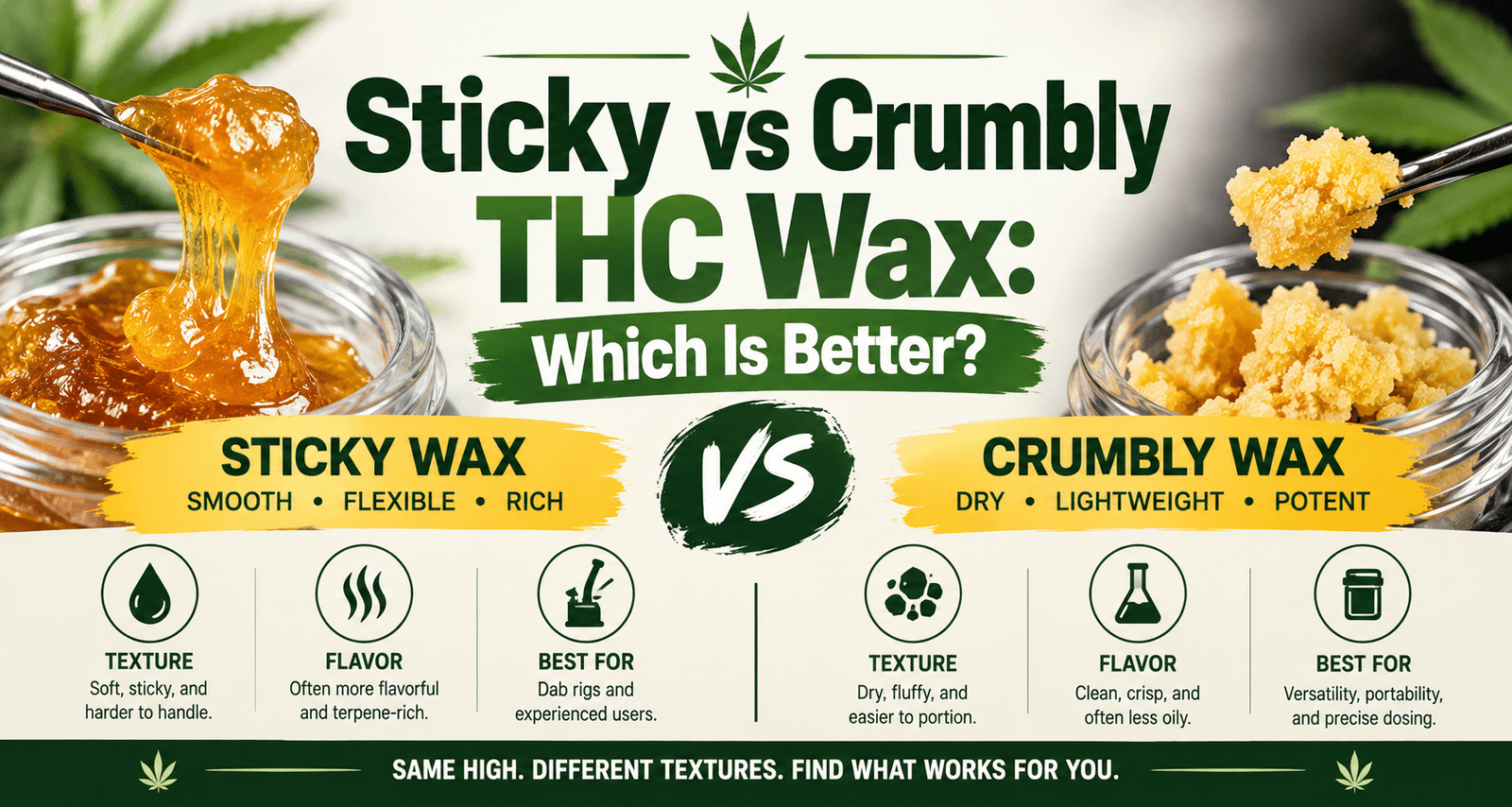
When shopping for THC wax, texture is one of the first things people notice. Some concentrates feel sticky, tacky, and soft, while others are crumbly, dry, and easy to break apart. This often leads to a simple question: Sticky vs Crumbly THC Wax: Which Is Better?
The answer is not as simple as choosing the texture that looks more appealing.
Sticky and crumbly wax can both occur naturally because of differences in extraction, cannabinoid and terpene content, moisture, storage conditions, processing methods, and temperature. A sticky texture does not automatically mean a concentrate is more potent or higher quality. Likewise, a crumbly texture does not automatically mean the wax is old or poor quality.
For consumers, texture is best understood as one characteristic among several. Aroma, appearance, consistency, laboratory testing, storage, and the product’s intended use can provide a much better picture of what you are actually buying.
This guide explains the differences between sticky and crumbly THC wax, what causes each texture, how temperature affects consistency, how to store each type, and what to look for when evaluating concentrate quality.
What Is Sticky THC Wax?
Sticky THC wax is a cannabis concentrate with a soft, tacky consistency that tends to cling to a dab tool or container.
The texture can range from slightly tacky to extremely adhesive. Some sticky concentrates can be shaped or moved without breaking apart, while others become much more fluid when warmed.
How Sticky Wax Typically Feels
Sticky wax may:
- Cling to a dab tool.
- Stretch slightly when moved.
- Hold together instead of breaking immediately.
- Become softer as it warms.
- Feel more pliable than dry wax.
- Become firmer when cooled.
The exact consistency depends on the concentrate’s formulation and storage conditions.
Why Is THC Wax Sticky?
Several factors can contribute to a sticky texture.
Terpenes and Other Compounds
Cannabis concentrates contain cannabinoids and, depending on the product and extraction method, varying amounts of aromatic compounds such as terpenes.
Some terpene-rich concentrates naturally feel softer and more adhesive.
Temperature
Warm temperatures generally make wax softer.
A concentrate that feels moderately firm in a cool room can become considerably stickier when exposed to heat.
Processing
Post-extraction processing can influence the final texture. Different processing approaches can produce concentrates ranging from glassy and brittle to soft and wax-like.
Is Sticky Wax More Potent?
Not necessarily.
Texture does not provide a reliable measurement of THC concentration.
A sticky concentrate could contain a lower THC percentage than a crumbly concentrate, and the reverse could also be true.
The most reliable way to determine cannabinoid content is to check the product’s laboratory test results or certificate of analysis when available.
What Is Crumbly THC Wax?
Crumbly THC wax is a concentrate with a drier, less adhesive consistency that tends to break apart when handled.
Instead of stretching or sticking to a tool, crumbly wax may fracture into small pieces or soft granules.
How Crumbly Wax Typically Feels
Crumbly wax may:
- Break apart easily.
- Feel relatively dry.
- Leave less residue on a tool.
- Be easier to portion into small pieces.
- Become softer when warmed.
- Become harder and more brittle when cooled.
The term crumbly describes physical consistency rather than a specific chemical composition.
Why Does THC Wax Become Crumbly?
A dry, crumbly texture can result from several factors.
Processing and Purging
The way a concentrate is processed after extraction can influence its consistency.
Changes in temperature, pressure, agitation, and other processing variables can affect the final texture.
Temperature and Storage
Cold temperatures can make many concentrates firmer.
A wax that is soft at room temperature may become noticeably harder after prolonged exposure to cold conditions.
Natural Variation
Not every batch of concentrate develops the same consistency.
Two products with similar cannabinoid percentages can have noticeably different textures because of differences in starting material, extraction, processing, and terpene composition.
Does Crumbly Mean the Wax Is Old?
Not automatically.
Texture alone cannot establish a concentrate’s age.
A fresh concentrate can be relatively dry or crumbly depending on how it was produced, while an older concentrate can remain soft depending on its composition and storage history.
Sticky vs Crumbly THC Wax: What Is the Difference?
The biggest difference between sticky and crumbly wax is physical consistency, not necessarily potency.
Sticky wax tends to hold together and adhere to tools, while crumbly wax tends to fracture or separate more easily.
Sticky vs Crumbly Wax Comparison
| Feature | Sticky THC Wax | Crumbly THC Wax |
|---|---|---|
| Texture | Soft and tacky | Dry and breakable |
| Handling | Can cling to tools | Usually separates more easily |
| Portioning | May require more control | Often easier to break into pieces |
| Temperature response | Becomes softer with heat | Can become firmer when cold |
| Potency | Cannot be determined from texture | Cannot be determined from texture |
| Quality | Depends on multiple factors | Depends on multiple factors |
| Aroma | Varies by product | Varies by product |
| Storage | Cool, controlled conditions | Cool, controlled conditions |
Which Texture Is More Convenient?
That depends on personal preference.
Someone who wants a concentrate that can be manipulated easily may prefer a softer consistency.
Someone who wants to break off a small piece without dealing with a highly adhesive product may prefer a crumbly texture.
Texture Is Not a Quality Score
One of the most common mistakes is assuming:
Sticky = premium
or:
Crumbly = low quality
Neither statement is universally true.
A concentrate’s quality should be evaluated using multiple characteristics rather than texture alone.
Which Is Better: Sticky or Crumbly THC Wax?
There is no universal winner between sticky and crumbly THC wax.
The better texture depends on what you value when handling and storing concentrate.
When Sticky Wax May Be Preferred
Sticky wax may appeal to consumers who prefer:
- A soft consistency.
- A tacky texture.
- A terpene-rich sensory experience.
- A concentrate that can be shaped rather than broken apart.
- A softer product at room temperature.
When Crumbly Wax May Be Preferred
Crumbly wax may appeal to consumers who prefer:
- Easier separation.
- Less adhesive handling.
- A firmer consistency.
- Simple portioning.
- A drier texture.
What Should Matter More Than Texture?
When evaluating a THC wax product, consider:
- Laboratory-tested cannabinoid content
- Terpene information
- Aroma
- Appearance
- Packaging
- Storage conditions
- Production information
- Contaminant testing
- Legal compliance
- Freshness and product condition
The Practical Answer
If two products are otherwise comparable, the choice between sticky and crumbly wax can simply come down to handling preference.
Texture is primarily a physical characteristic, not a direct quality ranking.
Does Texture Affect THC Potency?
Texture and THC potency are related only indirectly.
A concentrate’s consistency does not provide a dependable way to estimate how much THC it contains.
Can You Tell THC Percentage From Appearance?
No.
A concentrate’s:
- Color
- Texture
- Stickiness
- Crumbliness
- Smell
cannot reliably tell you its exact THC concentration.
What Determines THC Potency?
Potency is primarily determined by the cannabinoid composition of the product.
For consumers, the best source of information is a current laboratory report or certificate of analysis associated with the specific batch.
Why Texture Can Be Misleading
Imagine two concentrates:
Wax A: Sticky and soft, labeled at 70% THC.
Wax B: Crumbly and dry, labeled at 85% THC.
The appearance of Wax A does not mean it is stronger simply because it looks more resinous or sticky.
Likewise, the dry appearance of Wax B does not mean it is weaker.
Potency Requires Testing
The most reliable distinction is:
Texture = physical property
THC percentage = laboratory-measured chemical property
These should not be confused.
What Causes THC Wax to Change Texture?
THC wax is not necessarily static after production.
Its physical consistency can change because of temperature, storage, handling, exposure to air, and changes in its chemical components.
Temperature
Temperature is one of the simplest factors affecting concentrate consistency.
Warmer Conditions
Heat can make wax:
- Softer.
- More fluid.
- More adhesive.
- Easier to spread.
Cooler Conditions
Cold conditions can make wax:
- Firmer.
- Less adhesive.
- More brittle.
- Easier to break apart.
Agitation
Repeatedly manipulating a concentrate can change how it feels.
Stirring, whipping, or otherwise working a concentrate can affect its physical structure.
Exposure to Air
Repeated exposure to oxygen can contribute to changes in cannabis compounds over time.
The product may gradually change in aroma, color, and consistency.
Moisture and Contamination
Introducing moisture, dirt, fibers, or other contaminants can affect the product’s condition.
For this reason, concentrate should be handled with clean equipment and stored in an appropriate sealed container.
Why Consistency Changes Are Not Always a Problem
A change in texture does not automatically mean a product has become unusable.
Some texture changes are simply physical responses to temperature or handling.
However, unexpected changes accompanied by unusual odors, visible contamination, or other signs of degradation deserve caution.
How Should Sticky and Crumbly THC Wax Be Stored?
Proper storage can help preserve the concentrate’s characteristics for longer.
Keep THC Wax Cool and Stable
Extreme heat can soften wax and accelerate chemical changes.
A stable, cool storage environment is generally preferable to repeated temperature swings.
Limit Light Exposure
Light can contribute to degradation of cannabinoids and other cannabis compounds over time.
Keeping concentrate in an opaque or light-protective container can reduce unnecessary exposure.
Reduce Air Exposure
A properly sealed container can help limit contact with oxygen and environmental contaminants.
Use a Suitable Container
Concentrates should be kept in containers designed for cannabis concentrates.
Avoid Frequent Temperature Cycling
Moving wax repeatedly between hot and cold environments can change its consistency.
For example:
Warm room → cold storage → warm room → cold storage
can create repeated texture changes.
A stable storage environment is generally easier on the product.
Keep Tools Clean
Clean tools help reduce the risk of introducing:
- Dirt.
- Hair.
- Food particles.
- Moisture.
- Other contaminants.
Storage Goal
The goal is not to force sticky wax to become crumbly or crumbly wax to become sticky.
The goal is to preserve the product’s original condition as much as reasonably possible.
How Can You Tell If THC Wax Is Good Quality?
Texture can provide information, but it should never be the only quality indicator.
Check the Product Label
Look for information such as:
- Product name.
- Batch or lot number.
- THC content.
- CBD content when applicable.
- Manufacturer or producer.
- Testing information.
- Packaging date where provided.
Look for Laboratory Testing
A reputable cannabis product should have appropriate testing information where required by the applicable market.
Laboratory testing can provide information that cannot be determined simply by looking at the wax.
What Can Testing Reveal?
Depending on the jurisdiction and laboratory panel, testing can provide information about:
- Cannabinoid concentrations.
- Terpene content.
- Microbial contamination.
- Residual solvents.
- Heavy metals.
- Other contaminants.
Evaluate Aroma
A cannabis concentrate can have a strong, distinctive aroma depending on its terpene profile.
A strange chemical, burnt, or otherwise unexpected smell can be a reason to investigate the product further.
Evaluate Appearance
Color can vary considerably between concentrates.
A particular shade should not automatically be treated as proof of quality.
Don’t Use One Visual Feature as a Quality Test
A better evaluation system is:
Testing + labeling + aroma + appearance + storage + production information
rather than:
Sticky = good
or:
Crumbly = bad
Sticky vs Crumbly THC Wax: Handling and Usability
Texture can make a noticeable difference in how a concentrate behaves during handling.
Handling Sticky Wax
Sticky wax can adhere strongly to tools and surfaces.
This can make it more difficult to move or portion without leaving residue.
Keeping the product at an appropriate temperature can make handling more predictable.
Handling Crumbly Wax
Crumbly wax can be easier to separate into small pieces because it breaks apart rather than stretching.
However, very dry material can also become difficult to control if it breaks into tiny fragments.
Which Is Easier to Portion?
Neither texture is universally easier.
It depends on:
- How dry the concentrate is.
- How warm it is.
- The specific container.
- The tool being used.
- Personal handling preference.
Consistency and Convenience
For some consumers, sticky wax feels easier to manipulate because it stays together.
For others, crumbly wax is preferable because it does not cling as strongly to tools.
The ideal texture is therefore partly subjective.
Common Myths About Sticky and Crumbly THC Wax
Cannabis concentrate texture is surrounded by several common assumptions.
Myth: Sticky Wax Is Always Stronger
False.
Stickiness cannot reliably indicate THC concentration.
Laboratory testing is a much better source of potency information.
Myth: Crumbly Wax Is Always Old
False.
Crumbly consistency can result from processing, temperature, formulation, and other factors.
Age cannot reliably be determined from texture alone.
Myth: Dark Wax Is Bad
Not necessarily.
Concentrates can naturally vary in color because of starting material, extraction, processing, and storage.
Color should be considered alongside other product characteristics.
Myth: Clear Wax Is Always Better
False.
Clarity alone does not establish cannabinoid potency, purity, or overall quality.
Myth: More Sticky Means More Terpenes
Not necessarily.
Sticky texture can be influenced by terpene content, but consistency is affected by multiple variables.
The Better Rule
Avoid using one characteristic as a shortcut for quality.
A concentrate should be evaluated as a complete product.
Sticky vs Crumbly THC Wax: Frequently Asked Questions
Is sticky THC wax better than crumbly wax?
Not automatically. Sticky and crumbly are different physical textures, and neither texture alone proves that one product is higher quality.
Is crumbly THC wax bad?
No. A crumbly texture does not automatically indicate a bad or old concentrate.
Why is my THC wax sticky?
Sticky consistency can be influenced by the concentrate’s composition, terpene content, processing method, temperature, and storage conditions.
Why did my THC wax become crumbly?
Cooling, drying, handling, processing characteristics, and storage conditions can all influence consistency.
Does sticky wax mean higher THC?
No. Stickiness cannot reliably indicate THC percentage.
Does crumbly wax mean lower THC?
No. Crumbliness does not reliably indicate cannabinoid potency.
Should THC wax be sticky or crumbly?
Either texture can occur naturally. The preferred consistency depends largely on the product and the consumer’s handling preference.
Does heat make THC wax sticky?
Heat generally softens many concentrates, which can make them feel more adhesive or fluid.
Does cold make THC wax crumbly?
Cold temperatures can make concentrates firmer and more brittle, although the exact response depends on the product.
Can THC wax change texture over time?
Yes. Temperature, oxygen exposure, handling, storage conditions, and chemical changes can affect consistency.
Does texture tell you if THC wax is fresh?
Not reliably. Freshness is better evaluated using product information, packaging dates where available, storage history, laboratory testing, aroma, and overall condition.
What is the best way to store THC wax?
Store it in an appropriate sealed concentrate container, away from excessive heat and light, while minimizing unnecessary exposure to air and contaminants.
Is dry THC wax safe?
Dryness alone does not determine safety. A product should be evaluated for its source, testing, labeling, storage, and signs of contamination or degradation.
Can you tell THC potency by looking at wax?
No. Visual appearance and texture cannot provide an accurate THC percentage.
Does sticky wax contain more terpenes?
Not necessarily. Terpene content can influence texture, but stickiness has multiple possible causes.
Is crumbly wax easier to use?
It can be easier to separate and handle, but extremely dry material may also break apart more than desired.
Is sticky wax harder to handle?
It can be. Highly adhesive wax may cling to tools or containers, especially at warmer temperatures.
What should I look for when buying THC wax?
Consider laboratory testing, cannabinoid content, terpene information, product labeling, producer information, packaging, storage conditions, and the overall appearance and aroma.
Final Answer: Sticky vs Crumbly THC Wax—Which Is Better?
There is no universal answer that makes sticky THC wax better than crumbly THC wax or vice versa.
Sticky wax is generally softer and more adhesive, while crumbly wax is generally drier and easier to break apart. These differences can result from processing, temperature, cannabinoid and terpene composition, storage, and handling.
The most important point is that texture does not equal potency or quality.
A sticky concentrate is not automatically stronger. A crumbly concentrate is not automatically old. A darker concentrate is not automatically inferior, and a lighter or clearer concentrate is not automatically superior.
The easiest comparison
Sticky THC wax:
- Soft.
- Tacky.
- Often clings to tools.
- Can become more fluid with heat.
- May appeal to people who prefer a pliable consistency.
Crumbly THC wax:
- Drier.
- More breakable.
- Usually less adhesive.
- Can become firmer in colder conditions.
- May appeal to people who prefer easier separation.
What Matters Most
When evaluating THC wax, prioritize:
- Reliable laboratory testing
- Accurate cannabinoid information
- Product and batch information
- Appropriate storage
- Aroma and overall condition
- Evidence of contamination or degradation
- Legal and regulated sourcing
Texture is useful for understanding how a concentrate behaves, but it should not be treated as a standalone quality test.
The simplest answer to “Sticky vs Crumbly THC Wax: Which Is Better?” is:
Neither texture is automatically better. The better choice depends on the product’s verified characteristics and the user’s preferred consistency.
Understanding that difference can help consumers avoid judging cannabis concentrates based only on appearance and instead focus on information that provides a more meaningful picture of the product.