
Blog/News
What Terpenes Are in Quality THC Wax? A Complete Guide to Flavor, Aroma, and Purity

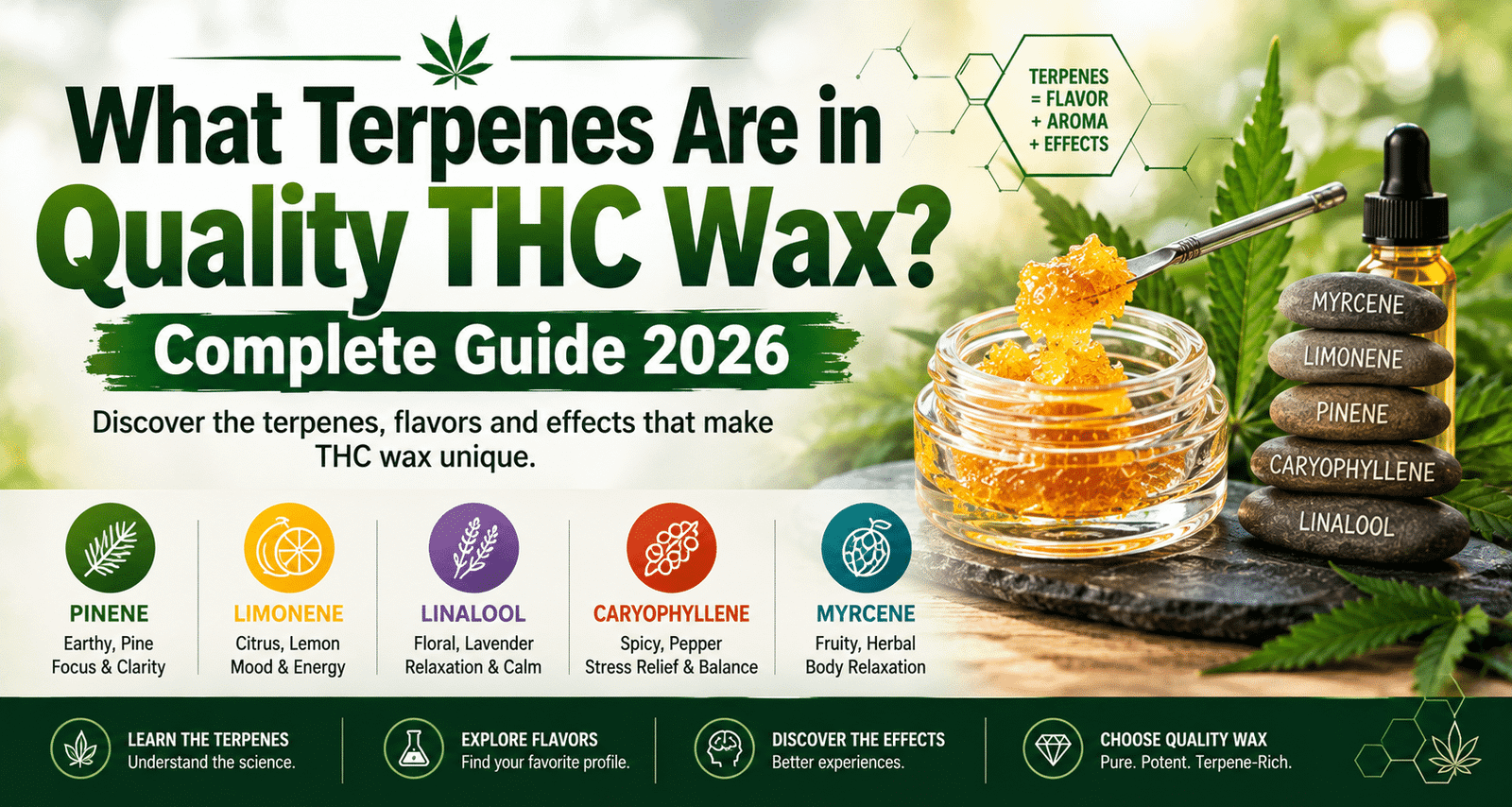
Terpenes are among the most important compounds to understand when evaluating the flavor, aroma, and overall profile of THC wax. While THC is the primary cannabinoid responsible for cannabis’s intoxicating effects, terpenes help determine whether a concentrate smells citrusy, tastes earthy, or carries notes of pine, pepper, flowers, or sweet fruit.
If you are wondering what terpenes are in quality THC wax, the answer depends on the cannabis strain, extraction method, processing conditions, and how the finished concentrate is stored. Common terpenes found in cannabis concentrates include myrcene, limonene, beta-caryophyllene, pinene, linalool, and humulene. Their proportions vary from one product to another, so there is no single terpene profile that defines every high-quality wax.
Understanding these aromatic compounds can help consumers interpret terpene labels, compare concentrate profiles, and distinguish desirable flavor characteristics from signs of poor storage or questionable manufacturing. However, aroma alone cannot establish purity, safety, or potency. Laboratory testing remains an important part of evaluating a cannabis concentrate. California’s Department of Cannabis Control explains that regulated cannabis testing can assess cannabinoids, terpenes, residual solvents, pesticides, heavy metals, and microbial contaminants.
This guide explains the most common terpenes in THC wax, how they influence flavor and aroma, what affects terpene preservation, and how to evaluate a product’s terpene profile using reliable information rather than marketing claims.
What Are Terpenes in THC Wax?
Understanding Terpenes and Their Role in Cannabis Concentrates
Terpenes are naturally occurring aromatic compounds produced by many plants, including cannabis. They contribute to the characteristic scents of citrus peels, pine needles, lavender, herbs, and numerous other plants.
In cannabis, terpenes contribute to the distinctive aroma and flavor profiles associated with different cultivars. A concentrate made from one cannabis variety may have a sweet, fruity aroma, while another may smell earthy, woody, or sharply citrus-like.
THC wax is a cannabis concentrate produced by extracting cannabinoids and other compounds from cannabis material. Depending on the extraction and processing method, the finished product may retain different amounts and combinations of the plant’s original terpenes.
Why Terpenes Matter in Quality THC Wax
Terpenes help explain why two concentrates with similar THC percentages can have noticeably different aromas and flavors.
For example, a concentrate rich in limonene may have a pronounced citrus character, while one containing more beta-caryophyllene may smell peppery or spicy. A myrcene-rich profile may feature earthy, herbal, or musky notes.
Three characteristics are particularly useful when evaluating a terpene profile:
- Aroma: The scent produced by the combination of aromatic compounds.
- Flavor: The sensory character associated with the concentrate’s volatile compounds.
- Composition: The identities and relative concentrations of the terpenes identified through laboratory analysis.
Terpene content is only one aspect of product quality. A concentrate can have a strong aroma but still contain unwanted contaminants. Likewise, a product with a subtle aroma is not automatically inferior.
Are Terpenes Responsible for THC Potency?
No. Terpenes and THC are different chemical compounds.
THC is a cannabinoid associated with cannabis’s intoxicating effects, whereas terpenes primarily contribute to aroma and flavor. Terpene composition may influence the overall sensory experience, but it should not be used as a substitute for measuring THC concentration.
Research into interactions between THC and terpenes continues to develop. The extent to which individual terpenes change the effects of THC in humans remains uncertain, and many popular claims about specific terpene-driven effects are not firmly established by clinical evidence. A review indexed in PubMed discusses the differences in evidence available for interactions between THC and other cannabis compounds.
What Are the Most Common Terpenes in Quality THC Wax?
Quality THC wax does not have to contain every known cannabis terpene. Instead, its profile depends on the starting material, the extraction process, and the manufacturer’s approach to preserving aromatic compounds.
Myrcene: Earthy, Herbal, and Musky
Myrcene is a commonly identified cannabis terpene associated with earthy, herbal, musky, and sometimes fruity aromas.
In THC wax, myrcene can contribute to a rich, grounded aroma that may remind consumers of damp earth, herbs, or ripe fruit. Its presence and concentration vary between cannabis varieties and concentrate types.
Myrcene is often discussed in connection with relaxing cannabis experiences, but its presence alone cannot reliably predict how a particular concentrate will affect an individual.
Limonene: Bright Citrus and Fresh Fruit
Limonene is known for its citrus-like aroma, which may resemble lemon, orange peel, or other fresh citrus fruits.
Concentrates with a prominent limonene profile may have a bright, sharp, or fruity aromatic character. It can also appear alongside other terpenes, producing more complex combinations of citrus, sweetness, and herbal notes.
Limonene is a useful example of why terpene profiles matter: two products with comparable THC levels can have different sensory characteristics because their aromatic compounds differ.
Beta-Caryophyllene: Peppery, Woody, and Spicy
Beta-caryophyllene is a terpene found in cannabis and other plants, including black pepper and cloves.
Its aroma is often described as spicy, woody, peppery, or warm. In THC wax, it can contribute depth and contrast to sweeter or fruitier aromatic profiles.
Beta-caryophyllene is also scientifically interesting because it interacts with the CB2 cannabinoid receptor. However, this does not establish that a particular wax product will deliver a specific therapeutic benefit.
Pinene: Pine, Forest, and Fresh Herbs
Pinene occurs in two commonly discussed forms: alpha-pinene and beta-pinene. Both are associated with pine-like and fresh herbal aromas.
A concentrate containing noticeable pinene may smell reminiscent of evergreen trees, fresh forest air, or aromatic herbs. Pinene can complement citrus and earthy notes, creating a sharper and more layered aroma.
The relative amounts of alpha-pinene and beta-pinene can differ between products, so a general label such as “pine terpene profile” does not provide the complete chemical picture.
Linalool: Floral and Lavender-Like
Linalool is commonly associated with floral aromas and lavender.
When present in cannabis concentrates, it may contribute soft floral notes that balance sharper, more pungent, or more herbal aromas.
Its concentration is not necessarily high in every cannabis cultivar, and it should not be assumed to dominate a concentrate simply because the product has a floral scent.
Humulene: Woody, Herbal, and Hoppy
Humulene is another terpene found in cannabis. It is also associated with hops and has a woody, herbal, and sometimes earthy aromatic profile.
In THC wax, humulene may contribute subtle depth to a mixture of terpenes. It can occur alongside beta-caryophyllene, myrcene, and other aromatic compounds.
The presence of humulene does not independently establish quality, but it can help explain the complexity of a concentrate’s overall aroma.
Other Terpenes That May Appear in THC Wax
Additional compounds may include terpinolene, ocimene, bisabolol, and nerolidol. Each can contribute a different aromatic characteristic, and their presence varies by cultivar and processing method.
Cannabis terpene research has identified numerous compounds, although not every compound appears in every variety or concentrate. A review of cannabis chemistry published in the scientific literature discusses the chemical complexity of cannabis and the diversity of its naturally occurring compounds.
How Do Terpenes Affect THC Wax Flavor, Aroma, and Overall Experience?
How Terpene Combinations Create Distinct Flavor Profiles
A concentrate’s aroma usually reflects a combination of compounds rather than one terpene acting alone.
Consider these illustrative profiles:
- Citrus-forward: Limonene with supporting herbal or pine-like notes.
- Earthy and herbal: Myrcene combined with other earthy aromatic compounds.
- Peppery and woody: Beta-caryophyllene alongside humulene.
- Floral and soft: Linalool within a broader aromatic mixture.
- Fresh and pine-like: Alpha-pinene and beta-pinene with complementary terpenes.
These descriptions are examples, not fixed formulas. The same terpene can smell or taste different within a complex mixture, and product processing can change which aromas are most noticeable.
Do Terpenes Change the Effects of THC Wax?
Terpenes are frequently marketed as indicators of whether a cannabis product will feel uplifting, calming, energizing, or relaxing. These descriptions should be treated cautiously.
Although laboratory research has investigated interactions between cannabinoids and terpenes, the evidence does not support reliably predicting an individual’s experience from a terpene label alone.
Factors such as THC concentration, the amount consumed, individual sensitivity, tolerance, and the product’s overall chemical composition may influence the experience.
Important distinction: A terpene profile can help describe aroma and composition, but it is not a dependable stand-alone predictor of intoxication, medical benefits, or safety.
Why Higher Terpene Content Does Not Always Mean Better Quality
More terpenes do not automatically make a concentrate better.
A high-quality product should be evaluated through several characteristics, including:
- A clearly identified product and batch.
- A reliable cannabinoid and terpene profile.
- Appropriate laboratory testing.
- Acceptable contaminant results.
- Accurate labeling.
- Evidence of suitable manufacturing and storage practices.
A concentrate with a moderate terpene concentration may have a more balanced aroma than one with a much higher concentration. Excessive or added terpene content can also raise product-specific safety concerns, particularly in inhalable products.
Quality should therefore be understood as a combination of composition, consistency, and safety rather than a contest to achieve the highest terpene percentage.
What Affects Terpene Quality and Preservation in THC Wax?
Extraction Methods and Terpene Retention
The extraction method can influence which aromatic compounds remain in a concentrate.
Some production methods aim to preserve the original plant’s volatile compounds, while others may produce concentrates with different terpene concentrations or ratios. The starting cannabis material also matters: its terpene profile places limits on which compounds are available to carry into the finished product.
Live resin, for example, is commonly produced from freshly harvested cannabis material that is frozen to help preserve its chemical profile before extraction. Other concentrates may be produced from dried and cured material.
Neither the product name nor the extraction method guarantees a specific terpene concentration. The actual composition depends on the material, processing conditions, and finished product.
Heat, Light, Oxygen, and Storage
Terpenes are volatile compounds, meaning some can evaporate or change during processing and storage.
Exposure to unsuitable temperatures, light, oxygen, and extended storage can alter a concentrate’s aroma and chemical profile. Different terpenes also have different physical and chemical properties, so changes do not occur uniformly across every compound.
A noticeable loss of a product’s original aroma may indicate that its volatile profile has changed, although smell alone cannot establish the cause or determine whether the product is safe.
Can You Judge Terpene Quality by Color or Texture?
Not reliably.
THC wax can vary in color and consistency because of differences in the starting material, extraction, processing, and storage. A pale concentrate is not automatically purer, and a darker concentrate is not automatically contaminated.
Likewise, a glassy, crumbly, creamy, or sticky texture does not prove that a product contains a particular terpene profile.
Consumers should avoid relying on appearance as a substitute for laboratory results. If a product has an unexpected chemical odor, visible foreign material, damaged packaging, or questionable labeling, its appearance and smell should not be used to declare it safe.
Why Laboratory Testing Matters
A certificate of analysis (COA) provides information about the tested product or batch.
Depending on the laboratory and applicable regulations, a COA may report cannabinoid potency, individual terpene concentrations, and screening results for contaminants such as residual solvents, pesticides, heavy metals, and microbial impurities.
California’s Department of Cannabis Control describes these testing categories in its official laboratory-testing guidance. Illinois also provides a useful explanation of how to interpret a cannabis product’s certificate of analysis.
When reviewing a COA, check that:
- The product name and batch information match the package.
- The testing laboratory is appropriately accredited or authorized under the relevant regulatory framework.
- The cannabinoid results identify THC potency.
- The terpene results list individual compounds and their concentrations, where available.
- The relevant contaminant tests have acceptable results.
- The report is authentic and corresponds to the finished product.
A terpene percentage by itself does not establish that a product is free from harmful contaminants.
How to Evaluate a THC Wax Terpene Profile: FAQs and Practical Guidance
What Is the Best Terpene Profile for THC Wax?
There is no universally best terpene profile. The right profile depends on the aromatic characteristics a person prefers, while product quality depends on reliable composition data, appropriate manufacturing, and laboratory testing.
One consumer may prefer citrus-forward concentrates, while another may prefer earthy, floral, pine-like, or peppery aromas. These preferences do not establish which product is safer or more potent.
Which Terpenes Are Most Common in THC Wax?
Commonly reported cannabis terpenes include myrcene, limonene, beta-caryophyllene, pinene, linalool, and humulene. Their relative concentrations vary according to the cannabis cultivar, extraction process, and storage conditions.
A particular concentrate may contain only some of these compounds in notable amounts.
Does Quality THC Wax Have to Contain Natural Terpenes?
No single terpene profile defines quality. Some concentrates retain terpenes from the original cannabis material, while some products may contain added terpenes.
If terpenes have been added, accurate labeling and information about their source and suitability for the intended product are important. A product should not be assumed to contain only naturally retained cannabis terpenes unless its documentation supports that claim.
Is Live Resin Higher in Terpenes Than Other Wax?
Live resin is often produced with the goal of retaining the aromatic profile of freshly harvested, frozen cannabis. However, not every live resin product has a higher measured terpene concentration than every other concentrate.
The final terpene profile depends on the starting material, processing method, and finished product. Comparing laboratory results is more informative than relying on the product category alone.
Can Terpenes Tell You How Strong THC Wax Is?
No. Terpenes do not provide a direct measurement of THC potency.
To evaluate potency, review the cannabinoid results on the product label and, where available, its matching laboratory report. Terpene percentages describe a different part of the product’s chemical composition.
What Does a Terpene Percentage Mean?
A terpene percentage indicates the proportion of the tested product attributed to measured terpenes, according to the laboratory’s method and reporting units.
For example, a report showing 5% total terpenes indicates that the measured terpenes account for approximately 5% of the sample by weight if the report uses weight percentage. Always check the report’s units and testing method before comparing products.
Can Terpenes Degrade During Storage?
Yes. Temperature, light, oxygen, and time can change volatile aromatic compounds. The extent of the change depends on the terpene mixture and storage conditions.
Changes in aroma can provide clues about a product’s history, but they cannot determine its safety or confirm the presence or absence of contaminants.
Are Terpenes Safe to Inhale?
Safety depends on the specific compounds, their concentrations, the formulation, and the method of exposure. A compound’s presence in a plant or food does not automatically establish that inhaling it in concentrated form is safe.
Consumers should avoid assuming that a product is suitable for inhalation simply because its ingredients are described as natural. Follow applicable product guidance and regulations, and consult a qualified healthcare professional if you have questions about exposure risks.
How Can You Identify a Reliable THC Wax Product?
Look for accurate labeling, identifiable batch information, and an authentic laboratory report where available. Review THC potency, terpene composition, and applicable contaminant results rather than judging the product solely by its color, texture, smell, or advertised terpene percentage.
The most reliable indicator is documented product composition combined with appropriate safety testing—not a single terpene or a marketing claim.
Final Takeaway
Quality THC wax can contain a wide variety of aromatic compounds, with myrcene, limonene, beta-caryophyllene, pinene, linalool, and humulene among the commonly discussed cannabis terpenes. These compounds help explain the different citrus, earthy, spicy, pine-like, herbal, and floral characteristics found across concentrates.
However, terpene composition varies between products, and no single compound guarantees quality, potency, or a particular effect.
For a more informed evaluation, distinguish THC potency from terpene content, understand how extraction and storage can influence aromatic compounds, and use a product-specific certificate of analysis to assess composition and applicable safety tests.
In short, the best way to evaluate the terpenes in THC wax is to combine an understanding of aromatic chemistry with reliable laboratory data. This approach provides a more accurate picture than relying on strain names, appearance, aroma, or unverified claims alone.
This article is for educational purposes only and is not medical or legal advice. Cannabis laws and product-testing requirements vary by jurisdiction.