
Blog/News
THC Wax vs Edibles: Which Gets You Higher?

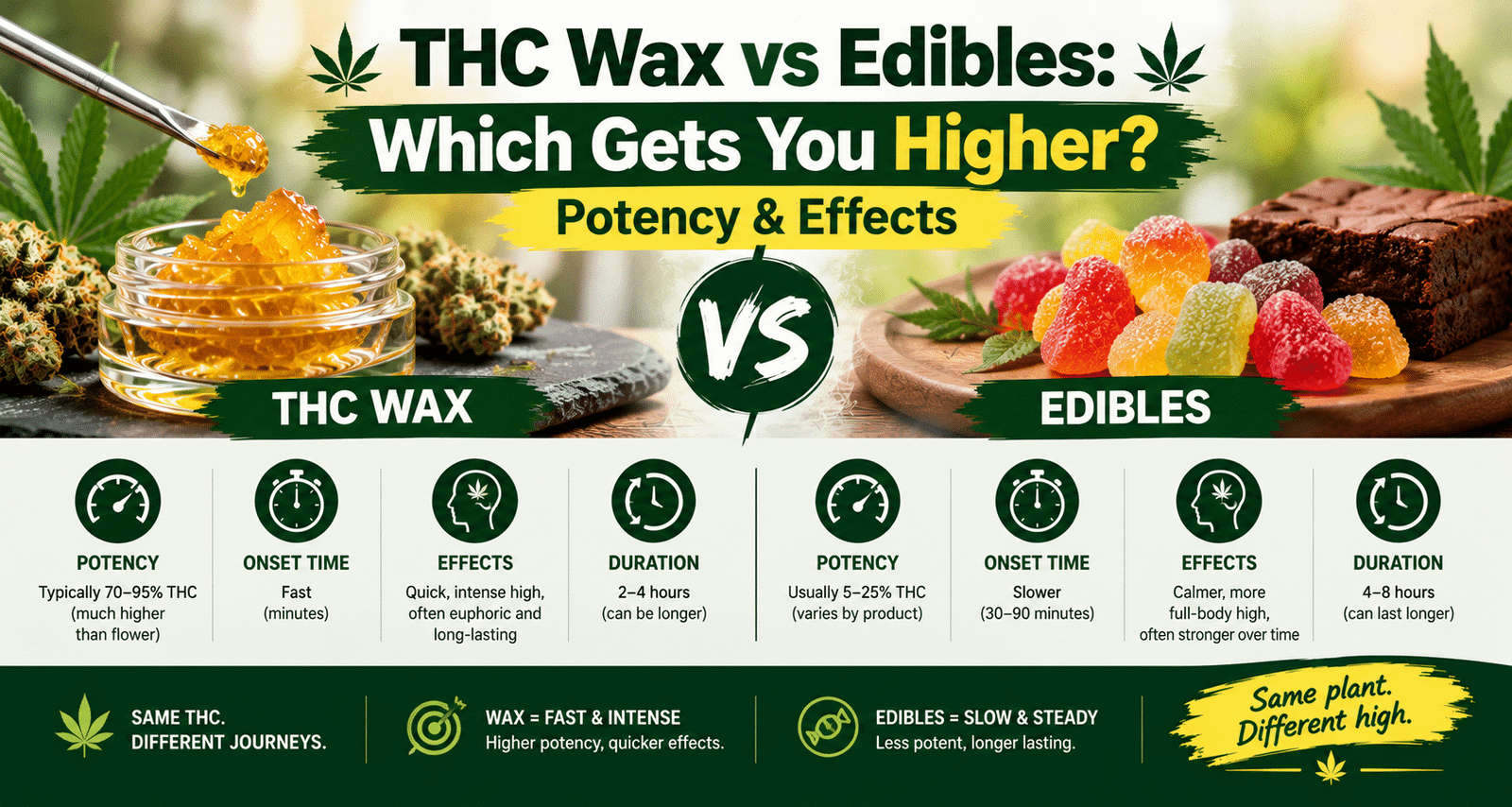
THC wax and cannabis edibles can both produce powerful intoxicating effects, but they affect the body in different ways. If you are comparing THC wax vs edibles to find out which gets you higher, the answer depends on THC potency, the amount consumed, your tolerance, and how your body processes cannabis.
THC wax is a concentrated cannabis extract that is typically inhaled, often producing effects within seconds or minutes. Edibles are foods or drinks containing THC that must pass through the digestive system, so their effects take longer to develop but can last considerably longer. The Centers for Disease Control and Prevention (CDC) warns that edible effects can be delayed and unpredictable, increasing the risk of consuming more THC than intended.
The short answer: THC wax can produce a rapid, intense high because it often contains highly concentrated THC. Edibles can produce a prolonged and sometimes unexpectedly intense high because the liver converts THC into an active metabolite called 11-hydroxy-THC. Neither method guarantees a stronger experience for every person.
Understanding these differences helps explain why two products containing THC can feel completely different, even when their labeled potency appears similar.
What Is the Difference Between THC Wax and Edibles?
The biggest difference between THC wax and edibles is how THC enters the bloodstream and reaches the brain. Wax is generally inhaled, while edibles deliver THC through the digestive system.
What Is THC Wax?
THC wax is a cannabis concentrate made by extracting cannabinoids from cannabis plant material. Its texture can range from soft and sticky to crumbly, depending on how it is produced.
Wax is often consumed through a method called dabbing, which heats the concentrate so its compounds can be inhaled. Some concentrates are also formulated for compatible vaporizing devices.
Why Is THC Wax So Potent?
Cannabis concentrates contain much more THC by weight than ordinary cannabis flower in many cases. Depending on the product, concentrates can contain very high THC concentrations, sometimes exceeding 60% or 80%.
This means a relatively small quantity of wax can contain a substantial amount of THC. However, the percentage on a label does not tell you exactly how much THC reaches the bloodstream or how intense the resulting high will feel.
The National Institute on Drug Abuse (NIDA) notes that highly concentrated cannabis extracts can deliver large amounts of THC and increase the risk of adverse effects, including anxiety, paranoia, and other psychological symptoms.
What Are THC Edibles?
THC edibles are cannabis-infused foods, beverages, or other products designed to be swallowed. Common examples include gummies, chocolates, baked goods, and infused drinks.
Unlike inhaled wax, edible THC passes through the digestive system before reaching the bloodstream. The liver then metabolizes some of the THC into 11-hydroxy-THC, an active compound that contributes to the intoxicating effects.
Why Can Edibles Feel Stronger Than Expected?
Edibles have a delayed onset. Someone may consume a product and feel little or nothing initially, even though THC is still being absorbed and processed.
When the effects eventually develop, they may feel stronger or last longer than anticipated. This delayed response is one reason edible overconsumption occurs.
The difference is important: wax is often associated with a rapid onset, while edibles are associated with a slower onset and a longer period of intoxication.
THC Wax vs Edibles: Which Gets You Higher?
THC wax often produces a faster and potentially more intense initial high, while edibles can produce a longer-lasting high that may feel equally or more intense for some people.
There is no universal winner because the outcome depends on the amount of THC, how efficiently it is absorbed, individual tolerance, and personal sensitivity.
Which Has the Higher THC Potency?
THC wax usually has a higher THC concentration by weight than traditional cannabis flower. Edibles, however, are commonly labeled by the total milligrams of THC in an individual serving and in the entire package.
These measurements are not directly interchangeable.
For example, a concentrate labeled 80% THC contains approximately 800 milligrams of THC per gram of product before accounting for losses during consumption and differences in absorption. An edible labeled 10 milligrams contains 10 milligrams of THC in the stated serving.
This comparison illustrates concentration, not an equivalent intoxicating effect. The amount actually absorbed differs substantially between inhalation and ingestion.
Why THC Percentage Does Not Predict the Entire Experience
A product’s THC percentage is only one part of the equation. The amount consumed, the route of administration, the product’s accuracy, and the individual’s metabolism also matter.
A highly concentrated wax product does not automatically produce a stronger experience than every edible. Likewise, an edible with a large labeled THC amount does not affect everyone identically.
Which Produces a More Intense High?
Wax can produce a noticeable change in perception within seconds or minutes. That rapid onset can make its effects feel immediate and intense.
Edibles may develop more gradually, with effects that build over time. Because orally consumed THC is metabolized differently, the resulting experience can feel different from inhaled cannabis rather than simply being a slower version of the same high.
Can Edibles Get You Higher Than Wax?
Yes, they can for some people.
An edible may produce a very intense and prolonged high, particularly when the amount consumed exceeds the person’s tolerance. However, some people experience more intense effects from inhaled concentrates.
The most accurate comparison is that wax often has the advantage in speed and concentrated delivery, while edibles often have the advantage in duration.
Which Is More Predictable?
Neither method is completely predictable, but each has different challenges.
With inhaled wax, effects begin quickly, making the initial response easier to notice. However, the high THC concentration can make it easy to underestimate the product’s strength.
With edibles, the delay makes it harder to judge the eventual intensity early on. Product labeling may also be inaccurate, and absorption can vary between individuals.
The CDC cautions that edible THC effects can take 30 minutes to two hours to appear, with longer delays possible in some circumstances.
How Fast Do THC Wax and Edibles Work, and How Long Do They Last?
The onset and duration of THC are among the most important differences between wax and edibles. Inhalation delivers THC rapidly through the lungs, whereas oral THC must pass through the digestive system and liver.
How Quickly Does THC Wax Work?
When THC wax is inhaled, effects can begin within seconds to a few minutes. The initial effects may become noticeable almost immediately, although the full experience can continue developing after the first inhalation.
The duration varies with the amount consumed, the product’s potency, tolerance, and other individual factors.
Typical THC Wax Timeline
- Onset: Seconds to minutes.
- Early effects: Often noticeable within the first several minutes.
- Duration: Commonly a few hours, with residual impairment potentially lasting longer.
These are general estimates, not guarantees. High-potency concentrates can cause substantial impairment, and a person may remain affected after the most noticeable sensations have faded.
How Quickly Do THC Edibles Work?
Edibles usually take longer to produce noticeable effects because THC must be digested and absorbed.
The CDC reports that effects may take 30 minutes to two hours to begin. The full effects can take longer to develop, depending on the product and the individual.
Typical Edibles Timeline
- Onset: Often 30 minutes to two hours, sometimes longer.
- Peak effects: May occur several hours after consumption.
- Duration: Often several hours, with some effects lasting 8–12 hours or longer.
The Washington State Liquor and Cannabis Board provides similar general guidance, describing edible effects as slower to begin and longer-lasting than effects from inhaled cannabis.
Why Do Edibles Last Longer?
When THC is swallowed, the digestive system and liver influence how the body absorbs and processes it. The liver produces 11-hydroxy-THC, an active metabolite that contributes to the distinctive effects of oral cannabis.
This metabolic process helps explain why an edible high can feel different from an inhaled high and why its effects may continue for hours.
The amount consumed, food intake, metabolism, medications, and individual sensitivity can all affect the timeline.
Why You Should Not Assume an Edible Has Failed
A delayed onset does not necessarily mean a product is ineffective. Taking additional THC before the original amount has fully taken effect can lead to unexpectedly intense or prolonged intoxication.
Avoid taking more simply because the effects have not appeared yet. Follow the product’s labeled directions and applicable medical advice, and do not combine cannabis with alcohol or other intoxicating substances.
What Are the Risks of THC Wax Compared With Edibles?
Both THC wax and edibles can impair memory, attention, coordination, judgment, and decision-making. Their risks differ partly because of how they deliver THC and how difficult it can be to judge the amount absorbed.
Risks Associated With THC Wax
Because wax can contain highly concentrated THC, inhaling it can expose the body to a substantial amount of the intoxicating compound.
Potential adverse effects include:
- Anxiety or panic.
- Paranoia.
- Dizziness and impaired coordination.
- Increased heart rate.
- Confusion or disorientation.
- More serious psychological symptoms in susceptible individuals.
Inhaling concentrates can also expose the respiratory system to harmful substances, depending on the product and method used. Contaminants or residual solvents may be a concern with improperly manufactured extracts.
Can THC Wax Cause an Overwhelming High?
Yes. High-potency concentrates can produce more THC exposure than a person expects, potentially leading to severe anxiety, panic, confusion, or other distressing effects.
High THC exposure is particularly concerning for people with low tolerance or a history of adverse reactions to cannabis.
Risks Associated With THC Edibles
Edibles have a different risk profile because their effects are delayed and may last longer than expected.
Potential adverse effects include:
- Severe anxiety or panic.
- Confusion and disorientation.
- Dizziness and impaired balance.
- Rapid heart rate.
- Nausea or vomiting.
- Paranoia or hallucinations in severe cases.
Accidental ingestion is another important concern, particularly when gummies, chocolates, or baked goods resemble ordinary food.
Can Edibles Cause a Longer Bad High?
Yes. If someone consumes more THC than intended, the effects may persist for many hours. The duration can be distressing, especially when anxiety or confusion develops.
If someone experiences severe symptoms, seek medical assistance. In the United States, Poison Control can be reached at 1-800-222-1222; call 911 for a medical emergency.
Which Is Safer: THC Wax or Edibles?
Neither product can be considered universally safe. The CDC states that cannabis products carry health risks regardless of how they are consumed, and research does not establish one consumption method as safer in every circumstance.
A useful distinction is that wax presents concerns related to concentrated THC exposure and inhalation, while edibles present concerns related to delayed onset, prolonged effects, and accidental overconsumption.
People who are pregnant, taking medications that may interact with cannabis, or living with conditions that could be worsened by THC should seek qualified medical guidance before using these products.
How Can You Reduce the Risk of Overconsumption?
If you choose to use a legal cannabis product, consider these precautions:
- Read the label and verify the THC amount.
- Avoid combining cannabis with alcohol or other intoxicating substances.
- Keep all cannabis products away from children and pets.
- Avoid taking additional edibles before the initial effects have fully developed.
- Do not drive, cycle in traffic, or operate machinery while impaired.
- Avoid products with unclear ingredients or unreliable potency information.
THC Wax vs Edibles: Frequently Asked Questions
Does THC wax get you higher than edibles?
Not necessarily. THC wax often produces a faster and potentially intense high because concentrates can contain high levels of THC. Edibles can produce equally intense or more prolonged effects in some people, depending on the amount consumed and individual metabolism.
Do edibles last longer than THC wax?
Generally, yes. Inhaled cannabis concentrates often produce effects lasting a few hours, while edible effects can last much longer, sometimes 8–12 hours or beyond. The actual duration depends on the person and the product.
Why do edibles feel different from dabs?
Dabs deliver THC through the lungs, allowing rapid absorption. Edibles pass through the digestive system and liver, where some THC is converted into 11-hydroxy-THC. This difference in absorption and metabolism changes the onset, intensity, and duration of the experience.
Is THC wax stronger than a 10 mg edible?
They cannot be compared reliably without knowing the amount of wax consumed and how much THC reaches the bloodstream. Wax is typically more concentrated by weight, but concentration alone does not determine the overall intoxicating effect.
Can edibles cause a stronger high than dabs?
Yes. Depending on the dose and individual response, an edible can produce an intense, long-lasting high. Another person might experience a more intense immediate effect from inhaled wax. There is no universal ranking that applies to everyone.
Which is better for beginners: THC wax or edibles?
Neither is risk-free for beginners. Concentrates may deliver high levels of THC rapidly, while edibles can be difficult to judge because their effects are delayed. People who are inexperienced with cannabis should be especially cautious and avoid high-potency products.
Can you mix THC wax and edibles?
Combining different THC products can increase total exposure and make impairment more difficult to predict. Using multiple products together can raise the risk of anxiety, confusion, and other adverse effects. Avoid combining them, particularly with alcohol or other intoxicating substances.
Can THC wax or edibles affect driving?
Yes. Both can impair reaction time, attention, coordination, and judgment. Edibles may continue affecting someone long after they first begin to feel high. Do not drive while impaired, and do not rely on feeling less high as proof that driving is safe.
Which has more THC, wax or edibles?
Wax usually has a higher THC concentration by weight. Edibles are generally labeled by milligrams of THC per serving or package. Because these units measure different things, a direct comparison requires the quantity consumed, not just the percentage or package label.
Can THC wax and edibles cause anxiety?
Yes. Both can cause anxiety, panic, or paranoia, especially when THC exposure is high or the individual is sensitive to cannabis. The effects may be particularly difficult to manage when an edible produces prolonged intoxication.
Does a stronger high mean a better experience?
No. A more intense high is not necessarily more enjoyable or safer. High THC exposure can increase the risk of panic, confusion, impaired coordination, and other unwanted effects.
Final Verdict: THC Wax vs Edibles — Which Gets You Higher?
THC wax generally delivers a faster, more immediate high, while edibles usually produce a slower-onset, longer-lasting experience. Which one feels stronger depends on THC exposure, metabolism, tolerance, and individual sensitivity.
Wax is often more concentrated by weight and can deliver large amounts of THC rapidly. Edibles are processed through the digestive system and liver, producing active metabolites that help explain why their effects may feel different and last longer.
Neither method guarantees a stronger high, and neither is risk-free. Concentrated wax can lead to unexpectedly intense effects, while delayed edible effects can encourage accidental overconsumption.
The most useful way to compare the two is to consider three separate factors: potency, onset, and duration. THC concentration describes the product, onset describes how quickly effects begin, and duration describes how long impairment may continue. These are related but distinct measures.
For anyone considering cannabis, the priority should be understanding the product’s THC content, recognizing that effects vary, avoiding combinations with other intoxicating substances, and never driving while impaired.
This article is for educational purposes only and is not medical advice. Cannabis laws and product regulations vary by location.